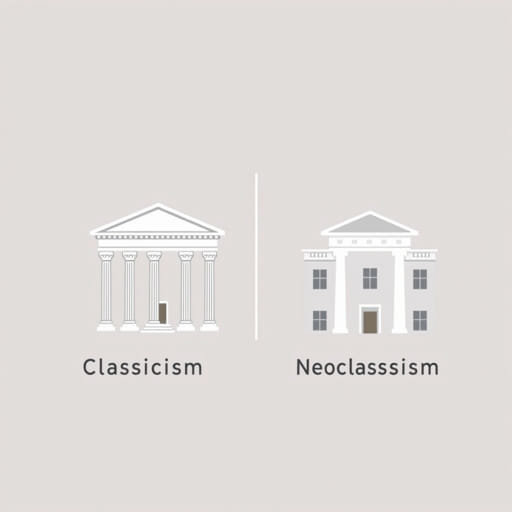
Throughout the history of art, literature, and architecture, the concepts of Classicism and Neoclassicism have played vital roles in shaping cultural aesthetics and philosophical ideals. While both movements share a deep appreciation for the traditions of ancient Greece and Rome, they arose in different historical contexts and express distinct values. Understanding the difference between Classicism and Neoclassicism is essential for students, scholars, and enthusiasts seeking to explore how Western civilization has interpreted beauty, order, and rationality over time. This distinction also helps us appreciate how societies revive and reinterpret the past to meet present needs.
Definition and Historical Context
What is Classicism?
Classicism refers broadly to the cultural traditions rooted in the art and thought of ancient Greece and Rome. It values harmony, proportion, clarity, and restraint. Emerging during antiquity, Classicism influenced not just architecture and sculpture, but also literature, drama, philosophy, and political thought. These ideals were revived and celebrated during the Renaissance, which is sometimes referred to as a Classical revival. In essence, Classicism is an adherence to the original standards set by classical antiquity.
What is Neoclassicism?
Neoclassicism is a later artistic and intellectual movement that emerged in the mid-18th century as a reaction to the ornate styles of the Baroque and Rococo periods. It looked back to the ideals of Classical antiquity as a model for rational structure, simplicity, and moral clarity. Unlike Classicism, which emerged from the classical world itself, Neoclassicism is a deliberate revival, informed by Enlightenment ideals and often politically motivated. It sought to apply ancient principles in a modern context, especially during times of social reform and political revolution.
Time Period and Origins
- Classicism: Originated in ancient Greece (5th century BCE) and Rome, reaching its peak during the Classical period (circa 480323 BCE). It reemerged during the Renaissance in the 14th to 16th centuries as part of a cultural rediscovery.
- Neoclassicism: Developed in Europe in the mid-1700s, especially in France, Britain, and Italy. It reached its height during the late 18th and early 19th centuries, parallel to Enlightenment thought and events like the French and American Revolutions.
While Classicism grew from a living tradition, Neoclassicism was fueled by archaeological discoveries such as Pompeii and Herculaneum, which reignited interest in the ancient world.
Philosophical Foundations
Classicism’s Ideals
Classicism emphasizes order, balance, rationality, and restrained emotion. It promotes the idea that beauty lies in symmetry and proportion, and it upholds ethical values derived from civic virtue and intellectual excellence. Classical art and literature often portray noble subjects, heroic figures, and idealized forms.
Neoclassicism’s Intellectual Roots
Neoclassicism was heavily influenced by Enlightenment rationalism. It adopted classical forms not only for their aesthetic value but also for their perceived moral and intellectual superiority. Neoclassicists believed that a return to classical ideals could help correct the excesses of previous styles and inspire virtue, discipline, and republicanism. This movement often carried political overtones, supporting democratic ideals and resistance to tyranny.
Artistic and Architectural Differences
Visual Characteristics of Classicism
In visual art, Classicism is characterized by simplicity, harmony, and proportion. Statues such as those of Phidias and Polykleitos display idealized human forms with balanced compositions. In architecture, classical temples like the Parthenon use columns, pediments, and strict symmetry to express clarity and stability.
Features of Neoclassical Art and Architecture
Neoclassical art mirrors classical forms but often emphasizes more austere and linear designs. Artists like Jacques-Louis David created paintings with sharp outlines, clear light sources, and morally uplifting themes. Neoclassical architecture, as seen in buildings like the Panthéon in Paris or the U.S. Capitol, uses columns and domes in a monumental, structured way. It aims to convey civic pride and political ideals through design.
Literature and Drama
Classical Literature
In ancient times, writers like Homer, Sophocles, Virgil, and Cicero shaped the literary canon of Classicism. Their works revolve around themes of fate, heroism, honor, and rational discourse. Drama was central, often focused on tragic or moral conflicts, with structured plotlines and elevated language.
Neoclassical Literature
Writers such as Alexander Pope, Voltaire, and Johann Christoph Gottsched adapted classical forms to contemporary concerns. Neoclassical literature values clarity, logic, and decorum, often using satire and allegory to critique society. Drama was also revived with strict unities of time, place, and action, echoing Aristotle’s principles but tailored for Enlightenment audiences.
Emotional Expression and Subject Matter
- Classicism: Encourages restrained emotion. Art is idealized and objective, avoiding extremes of passion or individual expression.
- Neoclassicism: Though still restrained compared to Romanticism, Neoclassicism may express moral outrage or civic duty. Characters in neoclassical works often face ethical dilemmas or exemplify stoic virtue.
The difference between Classicism and Neoclassicism becomes clear when analyzing how emotion is used Classicism focuses on harmony and universal ideals, while Neoclassicism may reflect contemporary moral and political tensions.
Influence on Society and Politics
Neoclassicism played a major role in shaping modern politics and institutions. In France and America, neoclassical architecture was adopted to symbolize democratic governance and civic virtue. Statues of Roman senators and Greek philosophers were installed in public spaces to connect modern republics with ancient democracies.
Classicism, on the other hand, shaped early educational systems and artistic standards. The classical canon formed the basis of grammar school education in Europe for centuries, promoting the idea that the best models for thought and art came from antiquity.
Legacy and Continuing Impact
Both Classicism and Neoclassicism continue to influence contemporary culture. Museums, monuments, and educational institutions around the world reflect their values. In graphic design, architecture, and public art, references to these movements lend a sense of authority, dignity, and timelessness.
Many modern artists and architects still study classical proportions and principles, while writers draw on neoclassical forms for satire, tragedy, and ethical reflection. Understanding these traditions helps explain the visual and literary languages we still encounter today.
Comparing Classicism and Neoclassicism
Though they share similar inspirations, Classicism and Neoclassicism differ in origin, context, and expression. Classicism is rooted in the ancient world and emphasizes eternal beauty and order. Neoclassicism, as a modern revival, reflects Enlightenment ideals and responds to the cultural needs of its own time. Recognizing these differences allows us to appreciate how each movement shaped our understanding of art, architecture, literature, and civic life. By studying both, we gain insight into how societies use the past to shape the present and imagine the future.