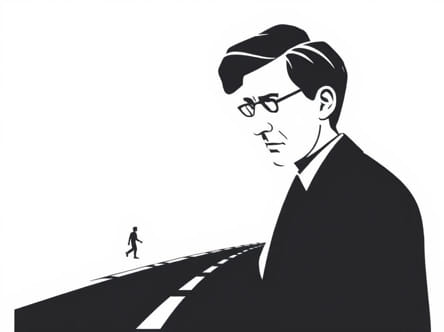
George Orwell is best known for his dystopian novels such as1984andAnimal Farm, which offer a chilling critique of totalitarianism. However, there is often a fascinating comparison made between Orwell’s ideas and those found in Friedrich Hayek’s workThe Road to Serfdom. Although Orwell did not write a book by that exact title, the themes presented in both Orwell’s writings and Hayek’s economic philosophy often align in unexpected and profound ways. Exploring Orwell’s political thought alongside Hayek’s arguments provides a deeper understanding of the fears and tensions surrounding authoritarian control, socialism, and liberty in the 20th century.
Contextual Background
George Orwell was a democratic socialist who believed in justice, equality, and civil liberty. His works often portray the dangers of unchecked power, the manipulation of truth, and the erosion of individual rights. Friedrich Hayek, on the other hand, was a classical liberal economist who warned against government overreach and central economic planning. InThe Road to Serfdom, published in 1944, Hayek argued that even well-intentioned central planning could lead to totalitarian regimes and the loss of personal freedoms.
Interestingly, despite Orwell’s different ideological starting point, he reviewed Hayek’sThe Road to Serfdomand acknowledged the danger of socialist movements turning authoritarian. This moment in intellectual history reveals a rare and honest reflection between two prominent thinkers on the potential pathways from idealism to oppression.
Similar Concerns About Totalitarianism
Both Orwell and Hayek shared concerns about totalitarianism, although they approached the issue from different angles. Orwell’s works depict the psychological and social consequences of living under authoritarian regimes. In1984, he created a world where government surveillance, propaganda, and censorship dominate every aspect of life. The result is a society where truth becomes relative and individuality disappears.
Hayek’sThe Road to Serfdompresents a theoretical argument. He believed that central economic planning, if pushed too far, leads inevitably to the erosion of freedom. According to Hayek, economic freedom is inseparable from political freedom. Once the government begins to dictate how resources are allocated, it gains power over people’s lives and choices, thus opening the door to tyranny.
Key Similarities
- Both warn against the concentration of power in the hands of the state.
- They recognize that freedom is not only political but also economic and intellectual.
- They oppose the idea that noble intentions, such as equality or justice, justify authoritarian control.
Points of Divergence
While Orwell and Hayek agree on the dangers of authoritarianism, they differ in how they define the threats and what the solutions might be. Orwell remained a democratic socialist, believing in the possibility of a just society that does not rely on centralized authority. He opposed Stalinism but maintained that a democratic form of socialism could avoid those pitfalls.
Hayek, in contrast, was skeptical of any form of collectivist economic planning. He believed that markets should be left to operate freely and that the role of the state should be minimal. In Hayek’s eyes, even democratic socialism carried seeds of tyranny because it required interference in the natural function of the market.
Philosophical Differences
- Orwell believed in the possibility of ethical socialism that preserves liberty.
- Hayek rejected socialism entirely, seeing it as incompatible with individual freedom.
- Orwell focused more on cultural and psychological aspects, while Hayek was rooted in economic theory.
The Influence of Industrialization and War
Another shared backdrop for both Orwell and Hayek was the experience of war and the rise of totalitarian regimes in Europe. Orwell fought in the Spanish Civil War, an experience that deeply influenced his views on the corruption of political ideals. He saw firsthand how revolutionary movements could devolve into authoritarianism.
Hayek, writing during World War II, saw the rise of fascism and communism as evidence that collectivist policies could destroy freedom. His book was a response to the growing popularity of socialist ideas in Britain at the time. He feared that postwar Britain could follow the same path if it embraced too much state control.
Reception and Legacy
Orwell’s review ofThe Road to Serfdomwas mixed. He respected Hayek’s warning but disagreed with his broad rejection of socialism. Orwell argued that liberty and justice had to go hand in hand. Nevertheless, the fact that Orwell took Hayek seriously shows a level of open-mindedness rare in political discourse.
Today, Orwell’s and Hayek’s works are both used across the political spectrum. Orwell is often cited by both leftists and conservatives as a critic of tyranny, while Hayek is revered by free-market advocates and libertarians. The intellectual exchange between these two men however limited continues to resonate in debates over the balance between freedom and social justice.
Continued Relevance
- The fears expressed by both thinkers are still relevant in modern political debates.
- Questions about the role of government, free speech, and economic control persist globally.
- Orwell’s fiction and Hayek’s non-fiction together offer a multifaceted warning against blind faith in authority.
Though George Orwell never wrote a book titledThe Road to Serfdom, his work shares striking parallels with the ideas presented in Friedrich Hayek’s famous book. Both thinkers, coming from different ideological backgrounds, warned against the dangers of unchecked state power and the erosion of individual liberties. Orwell approached the issue with a focus on justice and humanity, while Hayek emphasized the structural dangers of economic control. Together, their insights continue to guide conversations about governance, freedom, and the path societies may take intentionally or not toward oppression. The overlap between Orwell’s critique of authoritarianism and Hayek’s economic liberalism forms a compelling narrative about the fine line between order and tyranny, idealism and control.