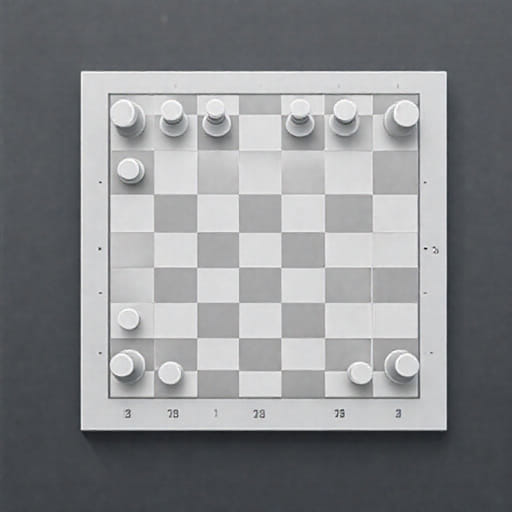
Whether you’re a beginner learning how to play chess or a seasoned player analyzing grandmaster games, the numbered and lettered chess board is an essential tool. This simple yet effective labeling system is crucial for understanding chess notation, recording moves, and communicating strategies. Every square on the chess board has a unique name thanks to the combination of letters and numbers, allowing players from around the world to interpret and replay games accurately. The system might appear technical at first, but once you understand how it works, it becomes second nature and enhances your overall chess experience significantly.
Understanding the Structure of a Chess Board
How the Grid System Works
A standard chess board consists of 64 squares arranged in an 8×8 grid. The horizontal rows are known as ranks, while the vertical columns are called files. To help players identify each square precisely, the ranks are numbered from 1 to 8, and the files are labeled with letters from ‘a’ to ‘h’. This results in every square having a unique coordinate, such as e4, d5, or h8.
The Purpose of Notation
This labeling system is known as algebraic notation, the universal language of chess. It serves multiple functions:
- Recording games for study or review
- Communicating moves in books, apps, and tutorials
- Allowing remote games or correspondence play
- Enhancing learning and strategic understanding
With numbered and lettered squares, players can easily pinpoint the origin and destination of any move, such as Nf3 (Knight to f3) or e5 (pawn to e5).
Setting Up the Chess Board Properly
Orientation of the Board
When placing the board correctly, make sure the bottom-right square is a light-colored square. The numbers should ascend from the closest rank (1 for White, 8 for Black) toward the opponent. The lettered files run left to right from ‘a’ to ‘h’ from White’s perspective. The square a1 is the bottom-left corner from White’s side, while h8 is the top-right corner from Black’s side.
Why Orientation Matters
Proper orientation ensures consistency in move notation and avoids confusion during gameplay. A misaligned board would result in incorrect coordinates, potentially invalidating game records or causing mistakes in tournaments.
Using Coordinates to Learn and Improve
Training With Square Names
Many beginner training methods use square identification exercises. For example, a coach might say place the bishop on c1 or move your queen to d4. This practice not only reinforces the board layout but also improves spatial memory and quick recognition during play.
Studying Openings and Endgames
Opening sequences are often described with exact moves using coordinates. For instance, a popular opening might begin with:
- 1. e4 e5
- 2. Nf3 Nc6
- 3. Bb5
These notations clearly show that the game started with a pawn moving to e4, followed by a knight to f3, and so on. In endgames, knowing square names is crucial for understanding key concepts like opposition, triangulation, and zugzwang, especially when explained by coaches or annotated literature.
Application in Digital Chess Platforms
Online Play and Analysis
Every major online chess platform uses algebraic notation with numbered and lettered chess boards. Moves are automatically recorded using these labels. This allows players to review their games, analyze mistakes, and even share games with others using notation such as PGN (Portable Game Notation).
Chess Engines and Tutorials
Chess engines evaluate positions and suggest moves using this same system. For instance, an engine might suggest Qd1 to h5 as the best move. Without the labeling system, understanding these suggestions would be far more difficult, particularly for newcomers.
Benefits of the Numbered and Lettered Chess Board
Universal Understanding
Regardless of country, language, or experience level, players around the globe use the same coordinate system. This universality allows players to study classic games played decades ago or communicate strategies with someone halfway across the world.
Efficient Game Replay
Notated games can be easily replayed on a physical or virtual board using the coordinates. Players can go through historical matches, understand move orders, and explore alternate lines all thanks to the standardized labels.
Facilitates Learning and Teaching
Coaches and students alike benefit from this system. Instruction becomes clearer, and students can follow along precisely. Whether it’s a tutorial on the Ruy Lopez or a YouTube breakdown of an endgame, coordinates keep explanations simple and direct.
Visual Patterns and Tactical Awareness
Understanding Diagonals and Files
Numbered and lettered boards help players understand and visualize patterns. For example, bishops operate on diagonals like a1h8 or c1g5, while rooks dominate files and ranks like a-file or 7th rank. Knowing these patterns improves tactical awareness and helps spot threats or opportunities.
Executing Combinations
Combinations often rely on precise square control. A fork might happen on e5, a pin might target the h4 square, or a discovered check might open up along the d-file. Being fluent in the board’s labeling helps players mentally map these patterns quickly and accurately.
Common Mistakes to Avoid
Incorrect Board Placement
Placing the board incorrectly is a common beginner error. Always remember: light square on the bottom right. This simple check ensures that a1 is always dark and h1 is always light, preserving the consistency of notation.
Misreading File and Rank
Beginners often confuse files and ranks. An easy trick is to remember that letters (ah) run left to right, and numbers (18) run bottom to top from White’s perspective. Thinking of a chessboard as a map helps reinforce this orientation.
Numbered and Lettered Chess Boards
The numbered and lettered chess board is more than a visual aid it’s a global standard that supports clarity, communication, and continuous learning in the world of chess. From studying famous matches to training tactics, this coordinate system empowers players at every level. Once internalized, it becomes an invaluable tool for mastering the game and navigating the complex yet fascinating world of chess strategy.