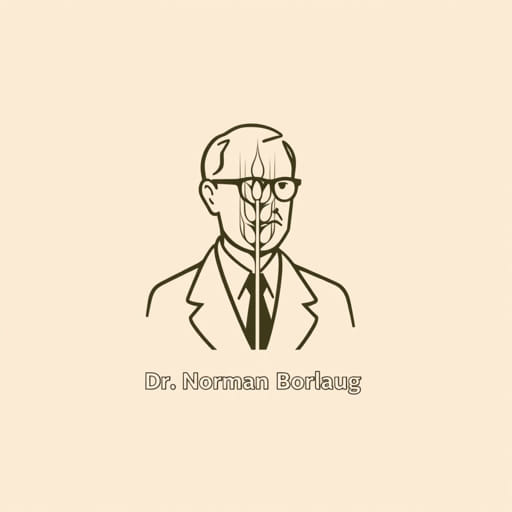
Dr. Norman Borlaug was a remarkable figure in agricultural science whose contributions helped save millions from starvation and revolutionized food production across the world. Born in the United States, Borlaug’s groundbreaking work in plant breeding and crop improvement led to what is famously known as the Green Revolution. While his work had a global impact, his nationality was American, and he is often honored as one of the greatest humanitarians of the 20th century. His story is one of scientific innovation, humanitarian commitment, and a relentless effort to combat hunger in some of the world’s poorest nations.
Early Life and Education
Humble Beginnings in Iowa
Dr. Norman Borlaug was born on March 25, 1914, in Cresco, a small farming community in the state of Iowa, United States. Raised on a modest family farm, he experienced the realities of rural life and agriculture from an early age. These early experiences would shape his understanding of farming challenges and sow the seeds of his lifelong mission to improve agricultural productivity.
Academic Journey
Borlaug pursued higher education at the University of Minnesota, where he studied forestry and later shifted his focus to plant pathology. He earned a Ph.D. in plant pathology and genetics in 1942, equipping him with the scientific knowledge that would soon fuel major global agricultural transformations.
Contributions to the Green Revolution
Work in Mexico
After completing his education, Borlaug began working with the Rockefeller Foundation in Mexico. His task was to address the country’s food scarcity by improving wheat yields. Through extensive research, experimentation, and collaboration with local farmers, he developed high-yielding, disease-resistant wheat varieties. These new strains could grow in diverse climates and significantly increased crop productivity.
Global Impact
The success in Mexico was just the beginning. Borlaug’s methods were later applied in other countries, notably India and Pakistan during the 1960s. These nations faced severe food shortages and risked famine. By adopting Borlaug’s wheat varieties and farming techniques, they dramatically boosted their agricultural output. In a few years, both countries transitioned from food-deficient to self-sufficient in wheat production.
Borlaug’s Legacy in India
Recognition and Impact
Though American by birth, Borlaug became a beloved figure in India due to his enormous contributions to the country’s food security. His role in increasing wheat production helped India avoid massive famines and laid the foundation for long-term agricultural stability. Indian scientists and farmers worked closely with Borlaug, who trained many in modern farming practices and crop management.
Award and Honor
In recognition of his efforts, Borlaug was awarded the Padma Vibhushan by the Government of India, one of the highest civilian honors in the country. Many refer to him as the Father of the Green Revolution in India, a title he shares with Indian agricultural scientist M.S. Swaminathan, who was instrumental in implementing Borlaug’s ideas in the Indian context.
Nobel Peace Prize and Global Recognition
Winning the Nobel
In 1970, Dr. Norman Borlaug was awarded the Nobel Peace Prize for his efforts to combat hunger and build a more peaceful world through increased food security. His award was unique it was not for political diplomacy or humanitarian relief but for scientific innovation that prevented conflicts born of scarcity. The Nobel Committee recognized that food security is foundational to peace and stability.
Other Awards and Achievements
Borlaug’s accolades extended beyond the Nobel Prize. He received the U.S. Presidential Medal of Freedom and the Congressional Gold Medal, two of the highest honors granted to civilians in the United States. Numerous universities awarded him honorary degrees, and institutions around the world recognized his monumental contributions to humanity.
Creation of the World Food Prize
Continuing the Mission
In 1986, Borlaug established the World Food Prize to honor individuals who made significant contributions to improving the quality, quantity, or availability of food in the world. The prize aims to inspire a new generation of agricultural scientists, innovators, and policymakers to address global food challenges. The annual award has become one of the most prestigious recognitions in the field of agriculture and food security.
Educational Outreach
Along with the World Food Prize, Borlaug was involved in education initiatives, mentoring young scientists and promoting agricultural research globally. His philosophy was simple but powerful: scientific advancement should serve humanity, especially the poor and hungry.
Was Norman Borlaug Indian?
While Dr. Norman Borlaug made immense contributions to Indian agriculture and is deeply respected in the country, he was not Indian. He was an American citizen and conducted much of his early work in the United States and Mexico. However, his collaboration with Indian scientists and the Indian government helped initiate a food revolution in the subcontinent. This has sometimes led to confusion about his nationality, especially among those familiar only with his Indian achievements.
Therefore, to answer the question clearly: Dr. Norman Borlaug was from the United States of America. His nationality was American, although his work benefited nations across the world, particularly developing countries in Asia, Latin America, and Africa.
Lasting Influence on Agriculture
Modern Agricultural Science
Dr. Borlaug’s work continues to influence agricultural practices today. His high-yield crops, emphasis on scientific farming, and advocacy for global food security remain relevant as the world faces new challenges such as climate change, soil degradation, and a growing population.
Inspiration for Future Generations
Borlaug serves as an inspiration for agricultural scientists, policymakers, and humanitarian workers. His belief that hunger could be eliminated through science and determination has motivated generations to continue innovating in the field of food production and sustainability.
Dr. Norman Borlaug was an American agricultural scientist whose efforts saved countless lives and reshaped global farming. Though not from India, his work had a transformative impact on the country and other developing nations. Through scientific breakthroughs, international cooperation, and relentless commitment, he helped create a more food-secure world. Today, his legacy lives on through modern agricultural research, the World Food Prize, and the improved lives of millions who no longer suffer from hunger. His story proves that science, when guided by compassion, can truly change the world.