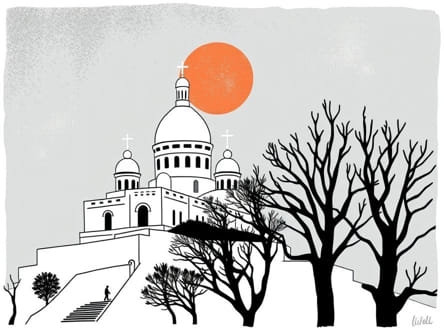
Perched on the highest point in Paris, the Sacré-CÅur Basilica in Montmartre is not only an architectural and spiritual landmark, but also an enduring muse for artists drawn to its grandeur and the charm of the surrounding district. One of the most notable painters to immortalize the Sacré-CÅur in his work was Maurice Utrillo, a French artist whose deep ties to Montmartre gave his paintings an unmatched sense of authenticity and emotional depth. His unique perspective helped capture the spirit of Montmartre and transformed the Sacré-CÅur from a religious icon into a symbol of artistic heritage.
The Historical Significance of Sacré-CÅur
The Basilique du Sacré-CÅur, or Basilica of the Sacred Heart, is one of Paris’s most recognizable monuments. Construction began in 1875 and was completed in 1914, though it wasn’t consecrated until after World War I in 1919. Built as a response to the turmoil of the Franco-Prussian War and the Paris Commune, Sacré-CÅur was intended as a gesture of hope, faith, and national repentance.
With its striking white domes and Roman-Byzantine architecture, the basilica dominates the skyline of Montmartre. It has become a focal point for tourists, worshippers, and artists alike, offering panoramic views of Paris and a peaceful ambiance above the bustling city.
Maurice Utrillo and Montmartre
Maurice Utrillo was born in Montmartre in 1883 to the artist and model Suzanne Valadon. His early life was marked by instability and personal struggles, including battles with alcoholism and mental illness. Despite these challenges, Utrillo discovered painting as a therapeutic outlet, and Montmartre became both his refuge and his canvas.
He was one of the few painters born and raised in Montmartre during its heyday as an artistic haven. Unlike some of his contemporaries who came to Paris from other regions or countries, Utrillo had a deeply personal connection to the area. This authenticity shows in his work, particularly in his depictions of local streets, cafés, and churches none more prominent than the Sacré-CÅur.
The ‘White Period’ and Utrillo’s Artistic Style
Utrillo’s most celebrated works come from what is known as his ‘White Period,’ spanning the years 1909 to 1914. During this time, he developed a distinctive technique involving the use of white zinc paint to achieve the muted tones and textures that became his hallmark. His scenes of Montmartre often appeared slightly somber or quiet, portraying the neighborhood in a reflective light rather than as a center of nightlife or excitement.
His paintings of the Sacré-CÅur typically feature the basilica framed by narrow Parisian streets or set against stark skies, emphasizing its scale and spiritual aura. Utrillo’s use of subdued colors and textured brushstrokes gave these works a poetic realism that resonated with viewers.
Utrillo’s Depictions of Sacré-CÅur
In many of Utrillo’s paintings, the Sacré-CÅur is shown not just as a church, but as an anchor of the neighborhood a silent observer of everyday Parisian life. Rather than focusing solely on religious iconography, Utrillo placed the basilica within the context of its urban surroundings, capturing:
- The cobblestone streets leading up to the hill of Montmartre
- The façades of modest homes and shops lining the route
- The quiet, sometimes overcast skies typical of Paris
- Everyday people walking, working, or simply living
Through this lens, Utrillo transformed Sacré-CÅur from a monument of faith into a lived-in part of the community. His works rarely glorified the church; instead, they invited contemplation, nostalgia, and an appreciation for the neighborhood’s raw beauty.
Representative Paintings
Some of the most well-known paintings by Maurice Utrillo that feature the Sacré-CÅur include:
- La Rue Saint-Rustique A quiet alleyway leading toward the basilica, reflecting Utrillo’s fascination with ordinary Montmartre streets.
- Montée de la Rue Muller A depiction of the steep climb to Sacré-CÅur, capturing the church at the end of a worn cobblestone path.
- Le Sacré-CÅur de Montmartre A frontal view of the basilica rendered with the soft whites and grays of his White Period palette.
These paintings are now part of collections in galleries and private homes around the world, continuing to communicate Utrillo’s unique vision to new generations.
The Legacy of Utrillo and Sacré-CÅur
Today, Maurice Utrillo is recognized as one of the most important painters of early 20th-century Montmartre. His contributions helped preserve a version of the neighborhood that was already changing during his lifetime. While tourism and commercialization have altered Montmartre’s character over the years, Utrillo’s work offers a window into its more intimate, quieter past.
The connection between Sacré-CÅur and Utrillo endures because it represents more than just religious architecture. It symbolizes an era of Parisian art, a neighborhood’s character, and the emotional journey of an artist who found solace in painting its streets.
Impact on Modern Perception of Montmartre
Thanks in part to Utrillo’s prolific depictions, the image of Montmartre as a place of rustic charm and bohemian beauty has been cemented in the cultural imagination. Tourists visiting the Sacré-CÅur today might still pass the very corners Utrillo painted, often unaware that those scenes once served as the backdrop for some of France’s most enduring art.
The relationship between Sacré-CÅur de Montmartre and Maurice Utrillo is a profound example of how art and place can influence one another. Through his paintings, Utrillo not only recorded the appearance of a beloved Parisian landmark but also elevated its role within the emotional and cultural fabric of the city. His work offers more than a visual representation it provides a sense of belonging, memory, and quiet reverence. For anyone interested in French art, urban history, or the enduring beauty of Montmartre, the name Maurice Utrillo will forever be linked to the majestic dome of Sacré-CÅur.