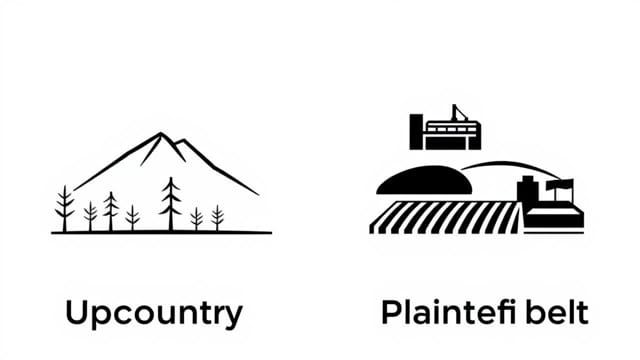
The distinction between the Upcountry and the Plantation Belt in the American South during the 18th and 19th centuries was rooted in geographic, economic, social, and political differences. These two regions represented contrasting ways of life and were central to the development of Southern identity. The Upcountry was generally characterized by small-scale farming, rugged terrain, and fewer enslaved individuals, while the Plantation Belt featured flat, fertile lands dominated by large plantations and a high concentration of enslaved labor. Understanding these differences is essential to grasp the economic and social structures that shaped the antebellum South.
Geographical Features and Land Use
The Upcountry Landscape
The Upcountry, sometimes called the Piedmont or backcountry, referred to the hilly and mountainous interior regions of Southern states like Georgia, South Carolina, and North Carolina. The land was less fertile and more difficult to cultivate on a large scale. Settlers in this region typically lived on small family farms, growing crops like corn, wheat, and vegetables for local consumption rather than for export.
Due to the topography and limited transportation routes, the Upcountry was more isolated. It did not have easy access to ports or major rivers, which further hindered large-scale commercial agriculture. As a result, economic independence and self-sufficiency became defining traits of Upcountry communities.
The Plantation Belt Terrain
In contrast, the Plantation Belt, also known as the Lowcountry or Black Belt in some areas, was characterized by flat, fertile lands ideal for growing cash crops such as cotton, rice, sugar, and tobacco. These regions were often located near rivers or coastal plains, enabling easier transportation and trade.
The availability of arable land and access to trade routes made the Plantation Belt a hotspot for large-scale agricultural production. This led to the growth of wealthy planter elites who built vast estates and relied heavily on enslaved labor to manage their operations.
Economic Activities and Labor Systems
Subsistence Farming in the Upcountry
In the Upcountry, agriculture was primarily subsistence-based. Farmers focused on producing enough food to support their families, with minimal reliance on market exchange. Most Upcountry residents could not afford enslaved laborers and instead relied on family labor. The local economy included bartering, trading within communities, and limited cash transactions.
Livestock such as pigs and chickens were common, and the cultivation of corn and grains was widespread. These farmers lived modestly and valued independence, which shaped their views on landownership, taxation, and government policies.
Cash Crop Economy in the Plantation Belt
The Plantation Belt’s economy was driven by export-oriented agriculture. Wealthy plantation owners focused on producing lucrative cash crops, especially cotton after the invention of the cotton gin. This region became deeply embedded in global trade networks, exporting products to Europe and importing manufactured goods.
Labor was largely performed by enslaved African Americans who worked under harsh conditions. Plantation owners accumulated wealth and political power, reinforcing a strict social hierarchy. Their economic interests led to strong advocacy for slavery and opposition to federal interference in local affairs.
Social Structures and Demographics
The Upcountry’s Egalitarian Social Fabric
Social life in the Upcountry was generally more egalitarian, at least among white settlers. Without the vast plantations and slave populations of the coastal regions, wealth inequality was less pronounced. Community cooperation and mutual aid were common, especially in farming and construction efforts.
Enslaved people were present but in much smaller numbers. This demographic reality contributed to differing attitudes toward slavery, with many Upcountry residents viewing it as an institution that primarily benefitted wealthy elites rather than themselves.
The Hierarchical Society of the Plantation Belt
By contrast, the Plantation Belt had a rigid social structure. At the top were the planter aristocracy wealthy white landowners who controlled large estates and hundreds of enslaved individuals. Below them were poor whites, many of whom worked as overseers, laborers, or tenant farmers.
The majority of the Black population in this region were enslaved, forming the backbone of the agricultural labor force. Social mobility was extremely limited, and power was concentrated in the hands of a few families who influenced regional politics, education, and the press.
Political Ideologies and Cultural Differences
Political Sentiments in the Upcountry
Many Upcountry residents distrusted the elite ruling classes of the coastal areas. They favored more democratic forms of governance and were skeptical of centralized political power. Early on, Upcountry communities often resisted calls for secession or any actions that would increase the power of the wealthy plantation elite.
These sentiments translated into a preference for policies that promoted land access, education, and limited government. Upcountry voters often supported populist leaders who advocated for the interests of small farmers and rural citizens.
Conservatism in the Plantation Belt
The Plantation Belt was politically conservative and protective of its economic structure, particularly slavery. Plantation owners exerted enormous influence on state legislatures and national politics. They pushed for policies that protected their economic interests, including tariffs, trade agreements, and laws that upheld the institution of slavery.
Culture in the Plantation Belt emphasized honor, tradition, and family legacy. Formal education was more available to the wealthy, and religious institutions often reflected the hierarchical nature of society.
Education and Religion
Limited Educational Access in the Upcountry
In the Upcountry, access to formal education was limited. Most children learned at home or in informal settings, with few public schools available. Education was often tied to religious instruction, and literacy rates varied widely.
Churches in the Upcountry were typically more democratic in structure. They served as important centers of community life, providing spiritual guidance and a place for social gatherings and discussion of local issues.
Elite Education in the Plantation Belt
The wealthy in the Plantation Belt had greater access to private tutors, boarding schools, and even European education for their children. Literacy was more common among the upper classes, and classical education was highly valued.
Churches often reinforced social stratification, and ministers were frequently aligned with the values of the planter class. Religious teachings were sometimes used to justify slavery and the social order.
Legacy of Regional Differences
The historical divide between the Upcountry and the Plantation Belt has had lasting effects on Southern culture, politics, and identity. These regions developed along different trajectories, shaped by their geography, economy, and social structures. While they both contributed to the broader Southern experience, their contrasting features often led to tension, especially in the lead-up to the Civil War.
Understanding the distinctions between the Upcountry and the Plantation Belt is crucial for interpreting Southern history. These differences influenced political affiliations, economic policies, and cultural attitudes that continue to resonate in modern American society.