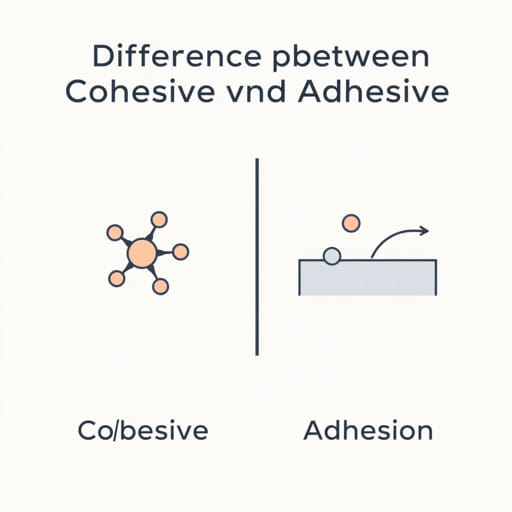
In the study of materials and liquids, understanding the forces that govern interactions is essential. Two fundamental types of forces are cohesive and adhesive forces, which influence everything from how liquids move on surfaces to the behavior of solid materials under stress. Cohesive forces are responsible for the attraction between similar molecules, whereas adhesive forces govern the interaction between dissimilar molecules or materials. These forces play critical roles in phenomena such as capillary action, wetting, lubrication, and the stability of liquids in containers. By examining their differences, applications, and underlying principles, we can gain a deeper understanding of how substances interact at a molecular level and how these interactions impact everyday life and industrial processes.
Understanding Cohesive Forces
Cohesive forces are the intermolecular forces that hold molecules of the same substance together. They are a key factor in determining the physical properties of a liquid, such as surface tension and viscosity. Cohesion arises from hydrogen bonding, Van der Waals forces, and other molecular attractions that create a stickiness” between molecules of the same type.
Examples of Cohesive Forces
- Water molecules sticking together due to hydrogen bonding.
- Mercury droplets maintaining a spherical shape on a surface.
- The formation of raindrops in the atmosphere.
Significance of Cohesion
Cohesion is important in many natural and technological processes. In plants, cohesive forces allow water to travel upward from roots to leaves through xylem vessels, a phenomenon known as capillary action. In liquids like mercury, cohesion results in high surface tension, enabling the metal to form beads on surfaces. Understanding cohesion helps in designing containers, measuring liquids accurately, and predicting fluid behaviors in microfluidic devices.
Understanding Adhesive Forces
Adhesive forces are the attractions between molecules of different substances. These forces determine how well a liquid wets or sticks to a solid surface. Adhesion is crucial in applications such as painting, coating, printing, and gluing, where interactions between different materials must be optimized to achieve strong bonds or uniform coverage.
Examples of Adhesive Forces
- Water spreading over a glass surface due to attraction between water molecules and glass.
- Glue sticking to paper or wood.
- Paint adhering to a wall surface.
Significance of Adhesion
Adhesion is central to both biological and industrial processes. In medicine, adhesive forces help in the application of bandages and wound dressings. In construction, proper adhesion ensures the longevity of coatings, tiles, and paints. Adhesive forces also contribute to everyday experiences, such as how liquids wet surfaces or how objects stick to one another. Engineers and material scientists study adhesion to develop adhesives with desired strength, flexibility, and durability.
Key Differences Between Cohesive and Adhesive Forces
While cohesive and adhesive forces are both intermolecular interactions, they differ in the types of molecules they involve and the effects they produce. Understanding these differences is crucial for interpreting physical phenomena and designing functional materials.
Comparison Table
- DefinitionCohesive forces are the attraction between like molecules, while adhesive forces are the attraction between unlike molecules.
- FunctionCohesion maintains the integrity of a single substance, whereas adhesion facilitates bonding or interaction with different substances.
- ExamplesCohesion water molecules forming droplets. Adhesion water spreading on a glass surface.
- Impact on Surface TensionCohesion primarily determines surface tension, while adhesion influences wetting and spreading on surfaces.
- ApplicationsCohesion capillary action in plants, mercury droplets. Adhesion adhesives, coatings, paints, and glue.
Interactions Between Cohesion and Adhesion
In many real-world scenarios, cohesive and adhesive forces work together to produce observable effects. For instance, when water climbs a narrow tube, adhesive forces pull the water up along the walls of the tube, while cohesive forces hold the water column together. The balance between these forces also determines the contact angle of a liquid on a surface, influencing how well it spreads or beads up. Engineers and scientists use this understanding to optimize fluid handling, surface coatings, and microfluidic devices.
Capillary Action Example
- Water rising in a thin glass tube demonstrates the combination of adhesion and cohesion.
- Adhesion pulls water molecules toward the glass walls.
- Cohesion maintains the continuity of the water column.
- The balance determines the height and shape of the liquid meniscus.
Practical Applications in Industry and Nature
The distinction between cohesive and adhesive forces is exploited in numerous industries and natural processes. In everyday life, we encounter both types of forces constantly, from liquid behavior in containers to the performance of adhesives and coatings.
Industrial Applications
- Designing adhesives with optimized strength for packaging, construction, and electronics.
- Formulating paints and coatings that spread uniformly on surfaces.
- Enhancing inkjet printing quality by controlling fluid spreading and wetting properties.
- Developing lubricants where cohesive properties prevent excessive spreading or leakage.
Biological and Natural Applications
- Water transport in plants through xylem vessels, where both cohesion and adhesion play roles.
- Surface wetting in insects’ legs and feet, enabling climbing on surfaces.
- Formation of raindrops and dew, influenced by molecular cohesion.
- Soil-water interactions and capillary movement of groundwater.
Challenges and Considerations
While cohesive and adhesive forces are fundamental, their measurement and manipulation present challenges. Surface contamination, temperature variations, and chemical composition can all affect the magnitude of these forces. Accurate experimentation and careful material selection are crucial for applications in coatings, adhesives, and fluid mechanics. Researchers must also account for dynamic interactions where cohesion and adhesion can change over time or under different environmental conditions.
Cohesive and adhesive forces are integral to understanding the behavior of liquids and materials in both natural and industrial contexts. Cohesion explains why molecules of the same substance stick together, influencing surface tension and structural integrity, while adhesion governs how different substances interact, affecting wetting, bonding, and spreading. Recognizing the differences between these forces allows scientists and engineers to manipulate materials effectively, optimize industrial processes, and explain many everyday phenomena. Whether in plant physiology, fluid mechanics, or material design, cohesion and adhesion provide fundamental insights into the interactions that shape our world.