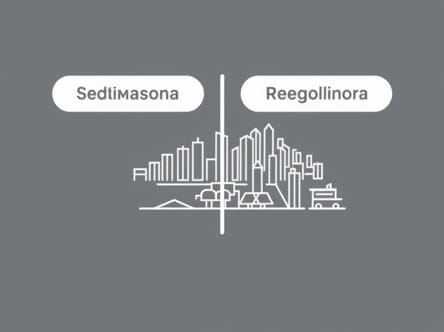
In modern geography and urban studies, the terms conurbation” and “metropolitan region” are often used to describe large urbanized areas. While both terms relate to urban expansion and the spatial patterns of population concentration, they describe different types of urban structures. Understanding the difference between a conurbation and a metropolitan region is essential for city planners, geographers, and anyone interested in how cities grow and function. Each concept reflects a distinct form of urban development, influenced by economic, political, and historical factors. This topic explores the definitions, characteristics, and major differences between conurbations and metropolitan regions in a detailed and accessible way.
Definition of Conurbation
What Is a Conurbation?
A conurbation is an extended urban area formed when multiple cities, towns, or urban centers grow and merge into a single, continuous metropolitan area. The term was first coined by Scottish urban planner Patrick Geddes in 1915 to describe the urban sprawl around major cities in England. Conurbations are usually the result of rapid population growth and economic expansion, where urban centers grow toward each other until they form one large built-up area.
Key Features of Conurbations
- Includes two or more major cities or towns
- Physically continuous urban spread
- Often lacks a single dominant urban core
- High degree of economic and infrastructural interconnection
Examples of well-known conurbations include the Ruhr region in Germany, the Randstad in the Netherlands, and the Greater Tokyo Area in Japan.
Definition of Metropolitan Region
What Is a Metropolitan Region?
A metropolitan region, also known as a metropolitan area, refers to a large urban center and its surrounding areas that are socioeconomically linked to it. This includes not only the city proper but also suburban and sometimes rural areas that are closely tied to the urban economy and infrastructure. A metropolitan region generally has one central city that acts as the core of the economic, cultural, and political activity.
Key Features of Metropolitan Regions
- Centered around one major city or urban core
- Includes surrounding suburbs and satellite towns
- Strong functional and commuting relationships with the central city
- Governance may involve coordination between multiple municipalities
Examples of metropolitan regions include the New York Metropolitan Area, the Delhi National Capital Region, and the São Paulo Metropolitan Region.
Structural Differences
Urban Form and Layout
The primary structural difference between a conurbation and a metropolitan region lies in their urban form. A conurbation is often polycentric, meaning it has multiple urban centers of nearly equal size and importance. In contrast, a metropolitan region is usually monocentric, dominated by one central city surrounded by dependent suburbs and towns.
- ConurbationPolycentric layout, with multiple main cities
- Metropolitan RegionMonocentric layout, with one central urban core
This difference in structure influences transportation systems, infrastructure development, and administrative coordination within the regions.
Economic Integration
Conurbations and Regional Economies
Conurbations often develop around industrial or commercial zones that expand over time. Since multiple cities are involved, economic activities are more distributed. Different areas within the conurbation may specialize in different sectors such as manufacturing, logistics, or services, leading to interdependence among urban centers.
Metropolitan Regions and Centralized Economies
In metropolitan regions, the economic focus is concentrated in the central city. Surrounding areas typically serve as residential zones or offer support services. The central city houses most corporate offices, major markets, and cultural institutions.
- ConurbationEconomically diverse and distributed
- Metropolitan RegionEconomically centralized around a core city
Governance and Administration
Administrative Complexity
Conurbations can be more complex to govern due to the involvement of multiple cities with separate local governments. Coordination between municipal authorities can be challenging, especially when addressing shared infrastructure, transportation, and environmental issues.
In metropolitan regions, although multiple local governments may be involved, there is often a more coordinated effort led by the central city. Metropolitan planning organizations may be established to manage regional development and services.
- ConurbationMultiple administrative units, complex coordination
- Metropolitan RegionCentralized governance with regional planning
Transportation and Connectivity
Urban Mobility
Both conurbations and metropolitan regions require efficient transportation systems, but their needs differ. Conurbations often have long-distance commuter routes connecting multiple major cities. High-speed trains, regional highways, and large logistics hubs are common features.
In metropolitan regions, transportation is more radial, with infrastructure designed to bring people in and out of the central city. Subways, buses, and local commuter trains are key elements.
- ConurbationExtensive inter-city networks
- Metropolitan RegionRadial transport systems centered on the main city
Examples and Case Studies
Conurbation Example The Ruhr Area, Germany
The Ruhr Area is a classic example of a conurbation. It includes cities such as Dortmund, Essen, Duisburg, and Bochum, which have grown into a continuous urban belt. Each city retains its identity but shares infrastructure and economic functions with others in the region.
Metropolitan Region Example Greater London
Greater London exemplifies a metropolitan region. The city of London is the urban core, surrounded by numerous boroughs and suburban towns. Despite their diversity, they function together economically and socially under a unified administrative structure.
Population Distribution
Differing Demographics
In conurbations, the population is more evenly distributed among the different urban centers. Each city contributes significantly to the overall population and urban footprint. In contrast, metropolitan regions tend to have high population density in the core city, with decreasing density toward the periphery.
- ConurbationBalanced urban populations across cities
- Metropolitan RegionPopulation concentrated in the central city
Urban Identity and Culture
Regional Identity
Conurbations often preserve the cultural and historical identities of their constituent cities. People may identify more with their local city than with the broader region. Metropolitan regions, on the other hand, tend to have a more unified cultural identity centered around the main city.
- ConurbationMultiple local identities
- Metropolitan RegionCentralized urban culture
Environmental and Land Use Implications
Urban Planning Challenges
Urban sprawl and land use are major concerns in both types of regions. Conurbations may face difficulties with fragmented land development and ecological degradation due to the merging of separate urban centers. Metropolitan regions often deal with overburdened infrastructure and urban congestion in the central core.
Planning Solutions
- Regional zoning policies
- Integrated public transportation
- Greenbelt and buffer zones
- Sustainable land management strategies
While conurbations and metropolitan regions both represent large, complex urban systems, they differ in structure, governance, economic focus, and cultural identity. Conurbations are formed by the physical merging of multiple cities, creating a polycentric urban area with distributed economic and administrative functions. Metropolitan regions, in contrast, revolve around a central city and include surrounding towns and suburbs that rely on the core for jobs and services. Understanding these differences is essential for urban planners, policymakers, and researchers working to build more sustainable and livable cities. Each model has its strengths and challenges, and effective urban development depends on recognizing and addressing the unique needs of each form.