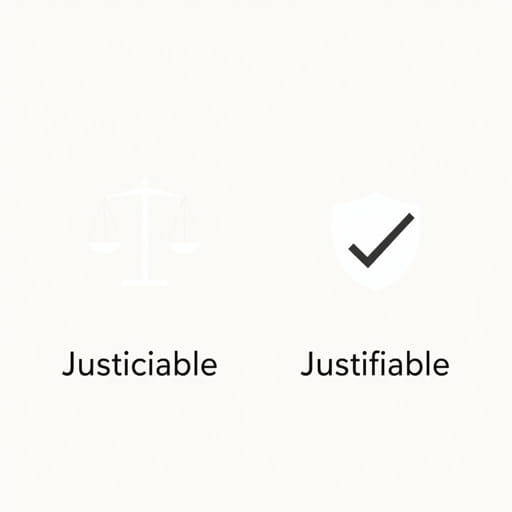
The terms justiciable and justifiable are often confused due to their similar spelling and sound, but they have very different meanings and applications, especially in legal and philosophical contexts. Understanding the distinction between these two words is important for legal professionals, students, and anyone who wants to use precise language in matters of law, ethics, and governance. While both terms can appear in legal discussions, they deal with entirely different concepts. One relates to the authority of courts to decide a matter, and the other relates to the moral or legal defense of an action.
Definition and Meaning
What Does Justiciable Mean?
Justiciable refers to issues or matters that are appropriate or suitable for adjudication by a court of law. In other words, a case is justiciable if a court has the authority and competence to hear it and make a binding decision. This includes meeting specific criteria such as the existence of a legal dispute, standing of the parties involved, and the presence of a real and substantive controversy.
For example, a dispute between two parties over a breach of contract is justiciable because it involves legal rights and obligations that a court can resolve. In contrast, a political question, such as whether a government should declare war, may not be justiciable because it is considered beyond the purview of judicial review.
What Does Justifiable Mean?
On the other hand, justifiable relates to whether an action or decision can be defended or explained with reason, logic, or moral grounds. A justifiable act may not necessarily be legal, but it can be rationalized or excused based on circumstances, intent, or social norms.
For instance, a person who breaks a traffic law to rush someone to the hospital in an emergency may have acted unlawfully, but their actions could be considered justifiable. The law might still apply penalties, but society could see the action as morally defensible.
Legal Relevance of Each Term
Justiciable Issues in Law
Courts are only permitted to adjudicate justiciable matters. This concept helps maintain the separation of powers, ensuring that courts do not interfere with executive or legislative functions. If a case is deemed non-justiciable, it means the court lacks jurisdiction, and the matter must be resolved by other governmental bodies or through political processes.
- Examples of justiciable matters: contract disputes, tort claims, constitutional rights violations, administrative law challenges.
- Examples of non-justiciable matters: foreign policy decisions, political questions, speculative or hypothetical issues.
Justifiable Acts in Law and Ethics
In contrast, the concept of justifiability is frequently used in evaluating defenses in criminal or civil cases. Courts may assess whether a defendant’s actions were justifiable under the law or under specific circumstances. Self-defense, necessity, and duress are examples of justifiable legal defenses.
Even if someone technically violates the law, the presence of a justifiable reason can lead to a reduced sentence or a not-guilty verdict. This shows how justifiability introduces a level of moral and practical flexibility into legal decision-making.
Comparison Between Justiciable and Justifiable
Key Differences
- Nature: Justiciable refers to whether courts can hear a case; justifiable refers to whether an action can be reasonably defended.
- Application: Justiciability applies to legal procedures and jurisdiction; justifiability applies to conduct and moral reasoning.
- Focus: Justiciability is about judicial authority; justifiability is about justification of actions.
- Example: Is this issue justiciable? versus Was the defendant’s action justifiable?
In Courtroom Practice
Judges and attorneys frequently deal with both concepts, but in different contexts. A case may be dismissed if it is not justiciable, meaning the court lacks power to decide it. However, if the case proceeds, the defendant may claim that their actions were justifiable in order to avoid liability.
Thus, both concepts play essential but separate roles in the administration of justice. Justiciability limits the kinds of disputes courts may entertain, while justifiability affects the outcomes of disputes based on moral or legal grounds.
Importance in Legal Theory
Why Justiciability Matters
The doctrine of justiciability protects the integrity of the judicial branch by ensuring it only resolves genuine legal disputes. It prevents courts from becoming involved in speculative or political matters where judicial intervention would be inappropriate or unconstitutional. This helps maintain public trust and the rule of law.
Why Justifiability Matters
Justifiability introduces nuance into legal evaluations. It reflects the idea that not all unlawful actions are morally or socially wrong. By considering justifiable motives or conditions, courts can deliver more equitable and humane judgments. It also allows for a broader interpretation of justice beyond rigid legal codes.
Common Confusions and Misuse
Due to their similar appearance, the words justiciable and justifiable are often used incorrectly, especially by non-native speakers or those unfamiliar with legal terminology. It’s important to remember:
- Justiciableis about whether a matter is suitable for court.
- Justifiableis about whether an action or decision can be defended.
Misusing these terms can lead to misunderstandings, particularly in legal arguments, academic writing, and policy discussions. Being precise with language enhances clarity and credibility.
Real-World Applications
In Government and Politics
Governments frequently encounter both concepts. For instance, a policy might be justifiable due to economic necessity but not justiciable in court due to separation of powers. Conversely, an unlawful surveillance practice may be justiciable and challenged in court but might be defended by the state as justifiable due to national security concerns.
In Everyday Life
Outside the legal arena, justifiability is a concept that many people use intuitively. Parents justify decisions to protect children, workers justify actions taken under pressure, and citizens justify civil disobedience to challenge injustice. Recognizing what is justifiable even if not lawful shapes public opinion, social movements, and policy change.
Although justiciable and justifiable sound similar, their meanings are distinct and critically important in different contexts. Justiciable matters concern the limits of legal authority and whether a court can hear a case. Justifiable actions, by contrast, deal with whether behavior can be defended logically or morally. Recognizing and correctly using these terms contributes to better understanding of the legal system, ethical reasoning, and social justice. Whether drafting legal documents or engaging in public debate, distinguishing between these concepts ensures clearer, more effective communication.