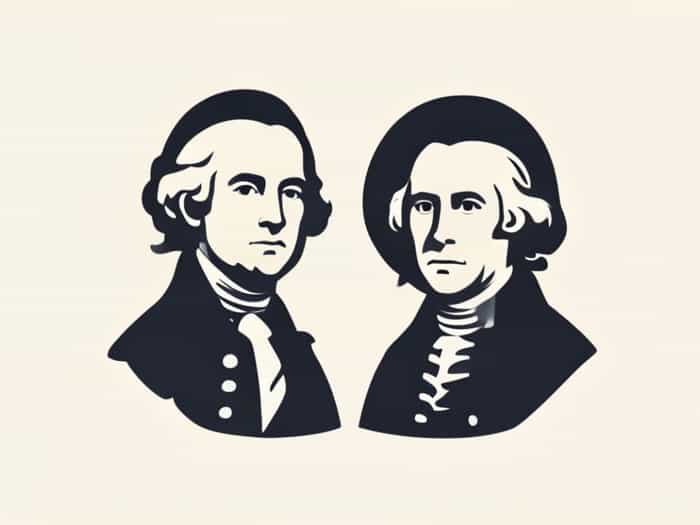
The early political landscape of the United States was shaped by fierce debates between the Federalists and the Jeffersonian Republicans. These two parties emerged in the late 18th century, representing distinct visions for the future of the nation. The Federalists, led by figures such as Alexander Hamilton and John Adams, advocated for a strong central government, a robust financial system, and close ties with Britain. In contrast, the Jeffersonian Republicans, spearheaded by Thomas Jefferson and James Madison, championed states’ rights, agrarian interests, and a more limited federal government. Understanding the ideological, economic, and social differences between these two parties is essential for grasping the foundations of American political history.
The Origins of the Federalist Party
The Federalist Party arose in the 1790s as a response to the challenges of governing a newly independent nation. Its leaders believed that a strong central government was necessary to maintain order, manage debts, and establish the United States as a credible force on the world stage. Alexander Hamilton, the nation’s first Secretary of the Treasury, was the intellectual architect of Federalist policies. He promoted the creation of a national bank, the assumption of state debts by the federal government, and the encouragement of manufacturing and commerce as key drivers of economic growth.
Federalists drew their support primarily from urban centers, commercial hubs, and regions with significant business interests. Their base included merchants, bankers, and professional classes who favored a structured government capable of regulating trade and ensuring economic stability. The party emphasized law, order, and the need for a capable federal system to prevent chaos and maintain national unity.
Federalist Policies and Philosophy
- Strong central governmentFederalists argued that a centralized authority could better manage national debt and enforce laws across the states.
- Economic developmentPolicies favored industrialization, banking, and infrastructure to promote economic growth.
- Pro-British foreign policyFederalists generally supported Britain in international affairs due to trade and political stability concerns.
- Loose interpretation of the ConstitutionThe party believed in implied powers that allowed the federal government flexibility in policy-making.
The Rise of Jeffersonian Republicans
In contrast, the Jeffersonian Republicans emerged as a response to what they perceived as overreach by the Federalists. Thomas Jefferson and James Madison advocated for a decentralized political structure, emphasizing the sovereignty of individual states and the protection of agrarian interests. Jeffersonians believed that the strength of the nation lay in its independent farmers, who embodied virtue, self-reliance, and democratic principles.
The Jeffersonian Republicans drew support mainly from rural areas, small farmers, and southern states. They feared that a strong central government could become tyrannical and undermine individual liberties. By promoting states’ rights and limited federal intervention, Jeffersonians sought to maintain a balance that would protect citizens from the concentration of power in Washington.
Core Beliefs of Jeffersonian Republicans
- States’ rightsJeffersonians emphasized local governance and autonomy to prevent federal overreach.
- Agrarian democracyThe party believed that farmers were the backbone of the nation and vital to maintaining freedom and morality.
- Pro-French foreign policyJeffersonians supported revolutionary France, reflecting their revolutionary ideals and anti-monarchist stance.
- Strict interpretation of the ConstitutionThey argued that the federal government could only exercise powers explicitly granted by the Constitution.
Major Conflicts Between the Federalists and Jeffersonian Republicans
The ideological differences between these two parties led to major conflicts over policy, governance, and the direction of the United States. One of the earliest disputes involved the creation of a national bank. Alexander Hamilton’s plan for the Bank of the United States was opposed by Jeffersonians, who viewed it as an unconstitutional expansion of federal power that favored wealthy elites at the expense of ordinary citizens.
Another significant conflict arose over foreign policy. Federalists sought to maintain favorable relations with Britain, emphasizing trade and security. Jeffersonian Republicans, on the other hand, sympathized with France, supporting the ideals of liberty and revolution. These differences influenced public opinion and political campaigns, often leading to intense debates in Congress and the press.
The Alien and Sedition Acts
The Federalists’ passage of the Alien and Sedition Acts in 1798 exemplified the clash between the parties. These laws, intended to suppress dissent and control immigration, were seen by Jeffersonian Republicans as a violation of the First Amendment and an abuse of federal authority. Jefferson responded with the Kentucky and Virginia Resolutions, asserting that states had the right to nullify unconstitutional federal laws. This confrontation highlighted the ongoing tension between centralized authority and states’ rights, a theme that persisted throughout early American history.
Political Culture and Elections
Elections during this period reflected the deep division between Federalists and Jeffersonian Republicans. The presidential election of 1800, often called the Revolution of 1800, marked a turning point in American politics. Thomas Jefferson’s victory over John Adams signaled the rise of the Jeffersonian Republican vision and a shift away from Federalist dominance. This election demonstrated that political power in the United States could transition peacefully between parties, setting a precedent for democratic governance.
Federalists remained influential in the early 19th century, particularly in New England, but their national power gradually declined. Jeffersonian Republicans consolidated their position, shaping policies that emphasized westward expansion, agricultural development, and limited federal intervention. These developments laid the groundwork for the evolving two-party system in the United States.
Impact on American Political Ideology
The debates between Federalists and Jeffersonian Republicans established enduring themes in American political ideology. Federalists emphasized national unity, economic modernization, and strong central authority, while Jeffersonian Republicans prioritized individual liberty, states’ rights, and rural democracy. These competing visions influenced subsequent political movements and continue to resonate in contemporary discussions about the balance between federal and state power.
Economic and Social Implications
The Federalist and Jeffersonian Republican divide also had significant economic and social implications. Federalist policies encouraged industrialization, urban growth, and the development of financial institutions. They believed that a thriving economy required a strong central government to regulate commerce and maintain stability. Jeffersonian Republicans, conversely, promoted agrarianism, small-scale farming, and self-sufficient communities. They argued that economic independence was essential for preserving democratic values and preventing corruption.
Socially, Federalists tended to align with elites, merchants, and professionals, while Jeffersonian Republicans drew support from farmers, artisans, and rural populations. This division reflected broader questions about who should hold power and influence in the young republic, shaping the political and cultural landscape of the early United States.
Legacy of the Federalists and Jeffersonian Republicans
The legacy of these early political parties extends far beyond their immediate influence. Federalists contributed to the establishment of a strong national framework, financial institutions, and an enduring foreign policy tradition. Jeffersonian Republicans reinforced the principles of states’ rights, individual liberty, and agrarian values, emphasizing the importance of citizen participation and local governance.
Together, these parties helped define the contours of American democracy, illustrating the dynamic tension between centralized authority and local autonomy. The ideological debates they initiated continue to inform modern political discourse, influencing contemporary discussions on federalism, civil liberties, and the role of government in society.
The Federalists and Jeffersonian Republicans played crucial roles in shaping the early United States. While they represented opposing visions of government, economy, and society, their debates established the foundation for American political culture. Federalists emphasized strong central authority, economic modernization, and international stability, whereas Jeffersonian Republicans championed states’ rights, agrarian democracy, and individual liberty. Understanding these parties provides valuable insight into the origins of the American political system, the development of ideological divisions, and the ongoing dialogue about the balance of power in a democratic nation. Their legacies remind us that political debate and compromise are essential components of a thriving democracy, and the lessons from this early rivalry continue to influence the United States today.