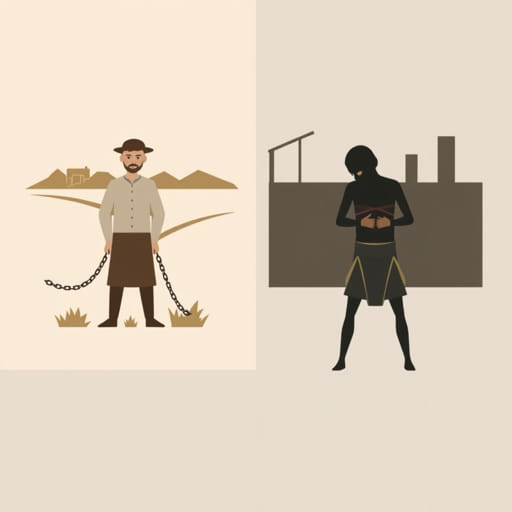
In the history of Russia, one of the most complex and debated institutions was serfdom. For centuries, millions of Russians lived under this system, tied to landowners and restricted in their freedoms. While it may resemble slavery in many ways, especially in the burdens imposed on individuals, there were distinct differences between serfdom and slavery. Understanding what distinguished serfdom from slavery in Russia helps clarify the social, legal, and economic conditions that shaped the lives of peasants under tsarist rule, as well as the broader structure of Russian society from the 17th to 19th centuries.
Legal Status and Rights
One of the clearest distinctions between serfdom and slavery in Russia was legal status. Serfs were not considered property in the same absolute sense as slaves. They were bound to the land and to a landlord, but they were not outright owned. This legal framework created a subtle but important boundary between the two systems.
Property vs. Obligation
- Serfs: Serfs were legally obligated to serve their lords and remain on their land, but they retained some limited rights, including the right to marry (with permission), own personal belongings, and pass on property to heirs. They could not be sold independently of the land.
- Slaves: Slaves, in contrast, were considered property in many legal systems. They could be bought, sold, and traded as commodities, with no recognition of individual rights or autonomy. In Russia, slavery as practiced in earlier periods (such as the kholopy system) allowed for such ownership, but by the time serfdom expanded, this had largely transformed.
Legal Protections
While serfs faced significant restrictions, they had some legal protection under Russian law. Courts could occasionally rule in favor of serfs if a landowner’s behavior was deemed too cruel or if certain obligations were not met. In contrast, slaves in traditional systems often had no legal standing and were completely at the mercy of their owners.
Attachment to Land
Serfdom in Russia was fundamentally a land-based institution. The primary duty of a serf was to work a portion of land owned by a noble or the state. This meant that serfs were tied not just to a person but to a geographic location, which played a major role in defining their condition.
Immobility and Control
Serfs could not legally leave the estate without permission, and attempts to flee were punishable by law. However, the fact that serfs were attached to a specific landholding made them a critical part of Russia’s agricultural economy and tied them to the broader feudal system.
Slaves, by contrast, were mobile property. They could be relocated, sold, or assigned to different tasks without consideration of land or community roots. In this way, the attachment to land gave serfdom a unique and more geographically bound character, even as it limited individual freedom.
Economic Functions and Labor
Both serfdom and slavery functioned to extract labor, but the nature of this labor and the economic structures behind it differed. Russian serfdom was deeply tied to the agrarian economy and the needs of a growing centralized state.
Labor Obligations
- Barshchina: Many Russian serfs owed barshchina, or labor dues, meaning they worked a certain number of days per week directly on their lord’s land.
- Obrok: Alternatively, some serfs paid obrok, or rent, often in money or produce, allowing them more independence to manage their own plots.
This dual system allowed for some degree of economic flexibility. In contrast, slaves typically worked without compensation or choice, and any economic benefit was solely for the slaveholder. Serfs might have personal plots and earn some income or produce for themselves, creating a layer of subsistence within the oppressive system.
Social Hierarchy and Status
In Russian society, serfs occupied the lowest formal rung of the social hierarchy, but they were still part of a legally recognized class. This distinguished them from slaves, who were often excluded entirely from legal or social recognition in other societies.
Roles and Identity
Russian serfs maintained family structures, religious affiliations, and village communities. These communal aspects of life were critical for survival and identity. They were baptized members of the Orthodox Church and recognized as citizens, albeit with very limited rights.
Slaves, in contrast, were often stripped of cultural and familial ties, particularly in systems based on racial slavery. They lacked personal agency and were frequently isolated or assimilated forcibly into dominant cultures. The fact that serfs retained cultural and familial identities marked a significant difference in lived experience.
Manumission and Social Mobility
Though limited, serfs in Russia had some pathways to freedom. A landowner could free a serf voluntarily, or a serf could purchase their own freedom in some cases. This was especially true in the urban context, where some serfs became merchants or artisans.
Slaves, in many systems, had little to no chance of gaining freedom unless through rare manumission or escape. While the odds were not favorable for most serfs, the possibility of change even if remote added a level of distinction between serfdom and absolute slavery.
Urban Serfs and Opportunity
Some serfs, especially those in towns and cities, had the opportunity to engage in trade, crafts, or service work. Over time, this allowed a small number of serfs to improve their status and even acquire wealth. Though still under their landlord’s control, these urban serfs lived differently from their rural counterparts and from typical enslaved populations.
Religious and Cultural Dimensions
The Russian Orthodox Church played a complex role in the institution of serfdom. While it often supported the feudal hierarchy, it also preached the spiritual equality of all souls. This duality sometimes offered moral arguments against cruelty and inhumane treatment, even if it did not call for abolition.
Slavery in other parts of the world was often reinforced by beliefs that slaves were fundamentally inferior. In contrast, the Church’s acknowledgment of serfs as fellow Christians sometimes limited how far landowners could go in justifying harsh treatment, though enforcement was inconsistent.
Abolition and Historical Legacy
Russia’s serfdom system lasted until 1861, when Tsar Alexander II issued the Emancipation Edict. This event marked one of the most significant reforms in Russian history. While serfdom ended legally, its economic and social effects continued to shape Russian life well into the 20th century.
The end of serfdom also highlights the distinction from slavery. Serfs were freed as a class through government action and compensated landowners. The process involved redefinition of rights, land redistribution (however limited), and long-term social change. The legacy of serfdom remained in patterns of rural poverty, land inequality, and peasant unrest.
In Russia, the distinction between serfdom and slavery lay in legal status, ties to the land, communal identity, and the limited but real rights serfs possessed. While both systems exploited labor and restricted freedom, serfdom involved obligations rather than outright ownership. Serfs were part of a rigid social system that allowed for minimal personal agency and occasional upward mobility, especially in urban settings. Understanding these differences offers crucial insight into Russian history, the development of feudalism, and the eventual push toward modernization and reform in the 19th century.