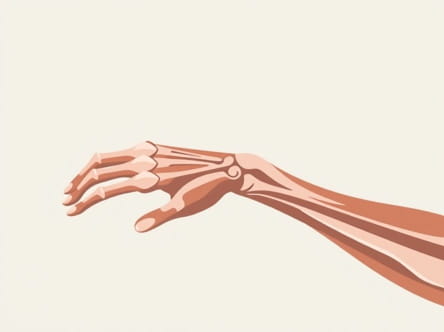
Ulnar deviation, also known as ulnar flexion or wrist adduction, is a specific wrist movement that involves bending the hand toward the ulna, the bone on the inner side of the forearm. This motion plays an essential role in various daily activities such as turning doorknobs, gripping objects, or stabilizing the wrist during fine motor tasks. Several muscles contribute to this action, working together to control the angle and strength of the wrist’s motion. Understanding the muscles responsible for ulnar deviation is important not only in anatomy but also in physical therapy, rehabilitation, and sports performance.
What is Ulnar Deviation?
Definition and Movement Description
Ulnar deviation is the movement of the wrist in which the hand shifts medially, toward the ulna bone of the forearm. It occurs in the frontal (coronal) plane and is typically measured in degrees of motion from the neutral wrist position. While the average range of ulnar deviation is around 30 to 40 degrees, this may vary slightly among individuals depending on flexibility, joint structure, and muscle condition.
Functional Significance
This motion allows the hand to move inward, which is crucial when handling tools, typing, or participating in sports that require wrist precision. It also contributes to load distribution across the wrist joint during weight-bearing or gripping actions.
Primary Muscles Responsible for Ulnar Deviation
Two main muscles are primarily responsible for producing ulnar deviation. These muscles act on opposite sides of the wrist but work together to draw the hand toward the ulnar side.
- Flexor carpi ulnaris (FCU)
- Extensor carpi ulnaris (ECU)
Flexor Carpi Ulnaris (FCU)
The flexor carpi ulnaris is a superficial muscle located on the anterior (front) side of the forearm. It originates from two heads the humeral head from the medial epicondyle of the humerus and the ulnar head from the olecranon process and posterior border of the ulna.
Insertion: The FCU inserts onto the pisiform bone, hook of hamate, and the base of the fifth metacarpal.
Function: The flexor carpi ulnaris contributes to both wrist flexion and ulnar deviation. It helps bend the wrist forward while simultaneously pulling it toward the ulna.
Extensor Carpi Ulnaris (ECU)
The extensor carpi ulnaris is located on the posterior (back) side of the forearm. It originates from the lateral epicondyle of the humerus and the posterior border of the ulna.
Insertion: The ECU inserts onto the base of the fifth metacarpal bone on the ulnar side of the hand.
Function: This muscle is primarily responsible for wrist extension and also assists in ulnar deviation by pulling the hand backward and medially.
Synergistic Action in Ulnar Deviation
Coordination of Muscle Groups
While the FCU and ECU have opposite functions in the sagittal plane (flexion vs. extension), they act as synergists during ulnar deviation in the frontal plane. When activated together, their opposing sagittal actions cancel out, resulting in a pure sideward movement toward the ulna.
Importance in Balanced Movement
This coordinated contraction is essential for wrist stability and control. If one muscle is weaker or injured, the wrist may deviate incorrectly or experience strain during repetitive activities.
Secondary Muscles and Supporting Structures
Although the FCU and ECU are the main contributors, other muscles indirectly support or stabilize the wrist during ulnar deviation:
- Flexor digitorum profundus: Helps flex the fingers and supports wrist flexion.
- Flexor digitorum superficialis: Assists in wrist flexion and stabilizing hand movements.
- Extensor digiti minimi: Located near the ECU, helps extend the little finger and provides lateral stabilization.
- Abductor digiti minimi: May help in subtle adjustments of hand movement toward the ulnar side.
Clinical Relevance
Common Conditions Involving Ulnar Deviation
Understanding the muscles responsible for ulnar deviation is especially important in diagnosing and treating wrist conditions. Some disorders include:
- Wrist sprains or tendonitis: Overuse of the FCU or ECU can lead to inflammation or micro-tears.
- Ulnar deviation deformity: Seen in rheumatoid arthritis, where the fingers angle toward the ulna due to joint damage and soft tissue imbalances.
- Ulnar nerve entrapment: May affect muscle coordination and strength in ulnar deviation.
Rehabilitation and Strengthening
Therapists often prescribe exercises that target the FCU and ECU to restore strength, improve range of motion, and prevent injury. Strengthening these muscles can help patients regain proper wrist function after trauma or surgery.
Exercises for Ulnar Deviation Muscles
Simple Training Techniques
- Wrist ulnar deviation with resistance band: Attach one end of a band to a fixed object and grip the other end. Slowly move the wrist toward the pinky side against the band’s resistance.
- Dumbbell ulnar deviation: Hold a light dumbbell with your arm resting on a bench, wrist hanging off the edge. Slowly move the wrist down toward the ulnar side, then return to neutral.
- Isometric holds: Press the side of your hand into a stable object (like a wall or desk) and hold for several seconds to engage ulnar deviators without movement.
These exercises are beneficial for athletes, musicians, or anyone performing repetitive wrist actions. It’s important to use proper form and gradually increase resistance to avoid strain.
Role in Sports and Daily Function
Performance and Endurance
Strong and well-coordinated ulnar deviation muscles help athletes maintain wrist stability in sports like tennis, golf, baseball, and gymnastics. In these activities, the wrist must often move side-to-side under pressure or hold awkward positions for extended periods.
In daily life, actions like using tools, driving, or typing require fine wrist adjustments involving ulnar deviation. Proper muscle function ensures these movements are smooth and pain-free.
Injury Prevention
Balanced strength between flexors and extensors around the wrist is key to preventing overuse injuries. Weakness in the FCU or ECU may lead to wrist imbalance, increasing the risk of strains or carpal tunnel-like symptoms.
The muscles involved in ulnar deviation primarily the flexor carpi ulnaris and extensor carpi ulnaris play a vital role in wrist movement, stability, and strength. Their combined action allows the hand to move toward the ulnar side with precision and control. Supporting muscles and tendons contribute to smooth motion and endurance, especially during complex tasks and athletic performance. Understanding how these muscles work not only aids in anatomy education but also provides insight for physical therapy, injury prevention, and overall wrist health. Maintaining strength and flexibility in these areas is essential for optimal hand and forearm function throughout daily life.