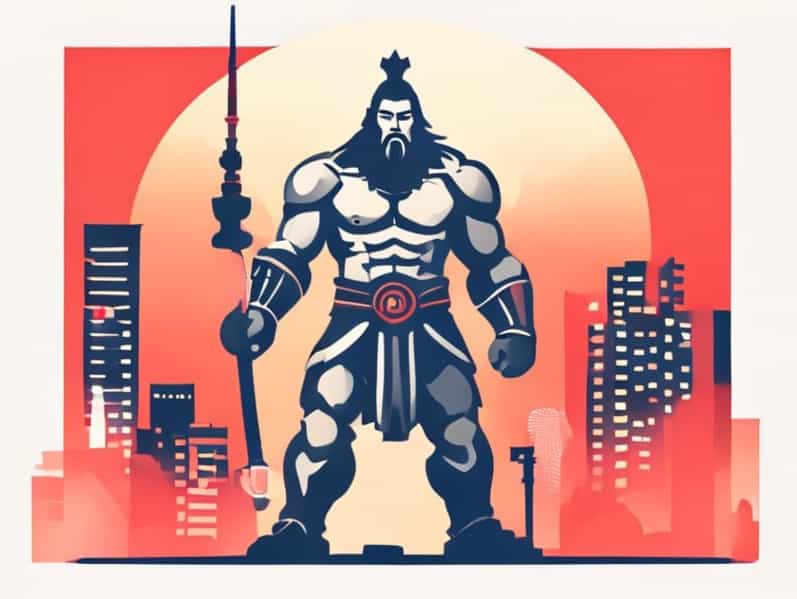
When the short film Giant God Warrior Appears in Tokyo was released, it instantly captivated audiences with its dark and powerful imagery. The film blends fantasy, mythology, and post-apocalyptic elements to create a story that feels both ancient and futuristic. It portrays a terrifying vision of destruction and rebirth, where gods and humans collide in a world on the edge of collapse. For many viewers, the short film became a fascinating look at what happens when divine power awakens in a modern city, leaving behind both awe and ruin. Its concept, visual effects, and message continue to inspire discussions among fans of Japanese cinema and animation alike.
Background of Giant God Warrior Appears in Tokyo
Giant God Warrior Appears in Tokyo (original Kyoshinhei Tokyo ni Arawaru) is a live-action short film produced by Studio Ghibli and directed by Shinji Higuchi. It was released in 2012 as part of an exhibit at the Museum of Contemporary Art Tokyo. The short film is closely connected to the Studio Ghibli classic Nausicaä of the Valley of the Wind, as the Giant God Warrior a massive, divine creature of destruction originates from that universe.
The short serves as both a prequel and a visual experiment. It explores what might happen if such a powerful being appeared in a modern setting like Tokyo. Unlike the peaceful worlds often seen in Studio Ghibli films, this story unfolds in a grim and realistic environment where the presence of the god warrior brings devastation.
Plot Overview
The story begins quietly, showing an ordinary Tokyo day. The atmosphere is calm, but tension grows as strange lights and tremors disturb the city. Soon, a massive being appears in the skyline the Giant God Warrior. Its towering body glows with energy, and its presence disrupts everything around it. As the film progresses, viewers witness the destruction caused by this godlike entity, as if ancient wrath has returned to punish humankind.
In just under ten minutes, the film presents a complete apocalyptic vision. Buildings crumble, the ground splits, and the sky burns with unnatural light. The narration, delivered with solemn intensity, explains that humanity once feared the wrath of divine beings but now, those ancient powers have returned to remind people of their insignificance.
Connection to Nausicaä of the Valley of the Wind
The Giant God Warrior first appeared in Hayao Miyazaki’s 1984 masterpiece Nausicaä of the Valley of the Wind. In that film, the God Warriors were massive weapons of the ancient world, responsible for the apocalypse known as the Seven Days of Fire. These beings destroyed entire civilizations with nuclear-like energy, leaving behind toxic wastelands. By showing the God Warrior in modern Tokyo, the short film bridges ancient myth and modern reality, suggesting that humanity’s destructive tendencies are timeless.
Fans of Nausicaä recognize the creature immediately the glowing eyes, skeletal body, and immense energy beam all recall the same unstoppable power from the earlier story. However, in Giant God Warrior Appears in Tokyo, the focus shifts from mythic fantasy to modern science fiction horror. It’s no longer a distant legend but a terrifying possibility.
Visual Effects and Production
One of the most impressive aspects of the film is its use of practical effects. Shinji Higuchi, who is well-known for his work on the Attack on Titan films and Shin Godzilla, directed the project using miniature sets, model effects, and digital compositing. The production intentionally avoided relying entirely on computer-generated imagery, instead embracing traditional special effects techniques known as tokusatsu.
This approach gave the film a tangible, realistic atmosphere. Tokyo’s destruction feels physical, with miniature buildings collapsing in clouds of smoke and debris. The Giant God Warrior itself was created using a combination of suit acting and digital enhancements, resulting in a creature that feels both real and supernatural. The lighting, camera work, and sound design together build a chilling sense of awe, making viewers believe that a godlike being has truly descended upon the city.
Symbolism and Themes
At its core, Giant God Warrior Appears in Tokyo explores humanity’s relationship with power, technology, and destruction. The film suggests that human civilization, despite its progress, remains vulnerable to forces beyond control whether divine, natural, or man-made. It can be interpreted as a warning about the dangers of hubris, the overreliance on technology, and the destructive potential hidden within human ambition.
1. Divine Retribution
The Giant God Warrior represents divine punishment a force that humans cannot understand or fight against. Its awakening in Tokyo can be seen as a metaphor for the consequences of modern society’s arrogance. Just as ancient civilizations were destroyed by their own creations, modern humans may face similar fate through their misuse of power.
2. The Fragility of Civilization
The film also highlights how fragile cities and societies are. Within minutes, Tokyo a symbol of modern achievement collapses into chaos. The sight of skyscrapers falling and streets melting under the god warrior’s energy beam is a stark reminder that no matter how advanced a civilization becomes, it can still be erased in an instant.
3. The Cycle of Creation and Destruction
Another theme reflected in the short film is the eternal cycle of creation and destruction. The narrator mentions that gods and humans share a similar fate both create, and both destroy. The appearance of the Giant God Warrior could symbolize the natural balance between these opposing forces a cycle that continues endlessly throughout history.
The Tone and Atmosphere
The tone of the film is haunting and apocalyptic. There are no human characters visible; the story unfolds entirely through visuals and narration. This decision adds to the sense of universal destruction it’s not about individual survival but the end of an era. The quiet voice of the narrator, combined with the overwhelming visuals, creates a feeling of despair and awe. It’s not horror in a conventional sense but something far more profound a spiritual catastrophe.
The atmosphere feels almost sacred, as if the destruction itself is part of a divine ritual. The burning city becomes an altar to the power of forgotten gods. The contrast between Tokyo’s bright, modern landscape and the god warrior’s ancient energy makes the imagery unforgettable.
Audience Reception
When the short film was first shown in Japan, it drew significant attention for its stunning visuals and deep symbolism. Many fans of Studio Ghibli were surprised by its dark tone since the studio is usually associated with warmth and wonder. Yet, this short reminded audiences that Ghibli’s imagination can also explore the terrifying side of creation.
Critics praised the use of miniature effects, calling it a rare example of craftsmanship in an era dominated by digital effects. Others viewed it as a commentary on Japan’s history with nuclear destruction, especially considering the country’s cultural memory of Hiroshima and the Fukushima disaster. The film’s portrayal of divine fire and total annihilation carries echoes of those real-world tragedies.
Legacy and Cultural Impact
Even though Giant God Warrior Appears in Tokyo is only a short film, its impact extends beyond its brief runtime. It demonstrated that Studio Ghibli could experiment with darker stories and different techniques. It also reignited interest in practical effects among Japanese filmmakers. The collaboration between Shinji Higuchi and Hideaki Anno, who later worked on Shin Godzilla, shows how this short served as a creative bridge between animation, live-action, and science fiction storytelling.
Today, the film continues to be discussed among anime and film enthusiasts for its artistic boldness and its message about human vulnerability. It stands as a unique example of what happens when traditional mythology meets modern urban life when the divine reenters a world that has forgotten it.
Lessons from Giant God Warrior Appears in Tokyo
The short film leaves viewers with more questions than answers, and that’s part of its brilliance. It doesn’t explain where the god came from or why it appeared; instead, it forces the audience to confront the idea that some powers are beyond understanding. It challenges the notion that humanity controls everything and reminds us that nature, technology, or divine will can turn against us without warning.
- It teaches humility recognizing the limits of human power.
- It warns against the dangers of overreliance on science without moral balance.
- It encourages reflection on how civilization shapes and sometimes destroys the world around it.
Giant God Warrior Appears in Tokyo is more than just a short film about destruction; it’s a visual poem about the power of creation, the fragility of human civilization, and the return of forgotten gods. Through its haunting imagery and profound themes, it shows that even in a world dominated by technology, ancient fears still live within us. The film’s mixture of mythology and modern realism makes it a timeless reminder that power, when uncontrolled, leads to inevitable ruin. For anyone interested in Japanese cinema, mythology, or apocalyptic storytelling, this short film remains a fascinating piece that continues to inspire reflection and awe long after the final scene fades to silence.