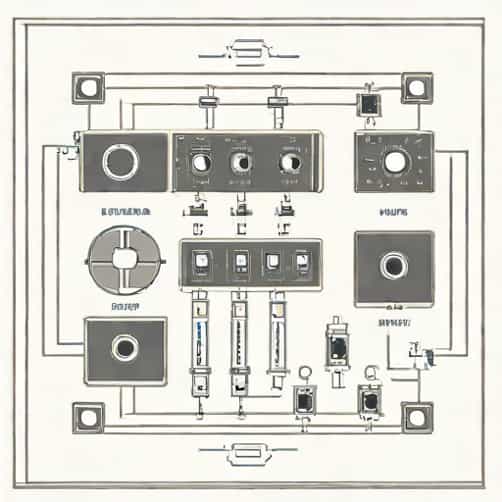
A multistage amplifier is an essential part of electronic circuits, especially when a single amplifier stage cannot provide the required voltage or power gain. To achieve higher amplification, several amplifier stages are connected together in series. Each stage increases the signal’s amplitude before passing it on to the next stage. The block diagram of a multistage amplifier helps to visualize how different amplifier stages are connected and how the overall amplification process takes place. Understanding this diagram is important for students, technicians, and engineers working with audio systems, communication circuits, or instrumentation amplifiers.
What Is a Multistage Amplifier?
A multistage amplifier is a combination of two or more amplifier stages connected in series, where the output of one stage serves as the input for the next stage. This configuration allows the overall voltage or current gain to be multiplied, resulting in a much stronger output signal. It is often used in applications such as radio receivers, microphones, and television circuits where high gain is required without significant distortion.
Purpose of Using Multiple Stages
The main reason for using a multistage amplifier instead of a single-stage amplifier is to achieve the necessary gain that one transistor or operational amplifier cannot provide alone. In addition to increasing gain, multistage amplifiers can improve bandwidth, input and output impedance matching, and overall stability. They are also used to separate functions such as voltage amplification and power amplification between different stages for better efficiency and performance.
Block Diagram of a Multistage Amplifier
The block diagram of a multistage amplifier represents how different amplifier stages are connected in sequence. Each block corresponds to one amplifier stage, and signals pass through coupling networks that ensure proper connection between stages while maintaining signal integrity.
The basic structure of a multistage amplifier can be represented as
- Input Stage
- Intermediate Stage(s)
- Output Stage
- Coupling Networks between each stage
- Power Supply Unit
1. Input Stage
The input stage is the first stage of the multistage amplifier. Its main function is to receive weak input signals and provide the initial amplification. The input impedance of this stage is usually kept high to avoid loading the source. In many designs, this stage uses a common-emitter or common-source configuration to achieve good voltage gain. It also ensures minimal distortion so that the signal remains clean for further amplification.
2. Intermediate Stage
The intermediate or driver stages are responsible for providing the bulk of the voltage amplification. There can be one or several intermediate stages depending on the required total gain. These stages use transistors or operational amplifiers and are coupled using various techniques such as RC coupling, transformer coupling, or direct coupling. Intermediate stages play a key role in determining the amplifier’s frequency response and overall stability.
3. Output Stage
The output stage is the final amplifier stage that delivers the amplified signal to the load, which may be a speaker, antenna, or another circuit. This stage is designed to provide sufficient power and proper impedance matching to drive the load effectively. Typically, it has a low output impedance and uses configurations such as an emitter follower or push-pull arrangement to deliver higher current without signal distortion.
4. Coupling Networks
Coupling networks are used between amplifier stages to transfer the AC signal while blocking DC components. This prevents DC biasing conditions from one stage from affecting the next. The main types of coupling used in multistage amplifiers include
- RC CouplingUses resistors and capacitors; ideal for low-frequency applications like audio amplifiers.
- Transformer CouplingProvides impedance matching and isolation; suitable for power amplifiers and communication circuits.
- Direct CouplingConnects stages directly without capacitors or transformers; used for DC and low-frequency amplification.
5. Power Supply Unit
The power supply provides the necessary DC voltage to bias all the stages of the amplifier. It must deliver a stable and noise-free output to ensure the amplifier functions properly. Any fluctuation in the supply voltage can introduce distortion or instability in the amplified signal.
Working Principle of a Multistage Amplifier
When a small input signal is applied to the amplifier’s input stage, it is amplified and passed to the next stage through the coupling network. Each subsequent stage increases the amplitude of the signal until it reaches the output stage, where the signal is strong enough to drive the connected load. The total voltage gain of the amplifier is the product of the individual gains of all stages.
Mathematically, if each stage has a gain of Aâ, Aâ, and Aâ, then the total voltage gain (Av) of the multistage amplifier is
Av= Aâ Ã Aâ Ã Aâ
This multiplication effect is what makes multistage amplifiers capable of producing high overall gain with smaller gains per stage, thus maintaining signal quality and reducing distortion.
Types of Multistage Amplifiers
Multistage amplifiers can be classified based on the type of coupling used between stages or based on their application. The main types include
1. RC Coupled Amplifier
This is the most common type of multistage amplifier used in audio and low-frequency applications. It offers wide frequency response and good voltage gain but is less efficient for high-power applications.
2. Transformer Coupled Amplifier
Used mainly in power amplifier stages, this type of amplifier employs transformers for coupling. It provides excellent impedance matching and high power transfer efficiency but may have a limited frequency response.
3. Direct Coupled Amplifier
In this design, stages are connected directly without coupling components. It is useful for amplifying DC or very low-frequency signals, as seen in instrumentation or operational amplifier circuits. However, it requires precise biasing to prevent drift or instability.
Advantages of Multistage Amplifiers
- Provides high overall gain by cascading multiple stages.
- Improves input and output impedance matching.
- Allows better control over frequency response and bandwidth.
- Reduces distortion when designed with proper biasing and coupling.
- Can handle both voltage and power amplification needs efficiently.
Applications of Multistage Amplifiers
Multistage amplifiers are used in many electronic systems due to their ability to deliver both voltage and power amplification. Common applications include
- Audio amplifiers in sound systems and musical instruments.
- Radio frequency amplifiers in communication systems.
- Signal conditioning in measurement and control instruments.
- Video amplifiers in televisions and display devices.
- Pre-amplifiers for microphones and sensors.
The block diagram of a multistage amplifier clearly illustrates how multiple amplifier stages work together to achieve the desired level of signal amplification. Each stage has a specific role – from initial signal processing to final power delivery. The coupling networks and power supply ensure smooth signal transition and stability. Understanding this structure helps in designing amplifiers that provide high gain, minimal distortion, and excellent performance across various frequencies. Whether in communication systems, audio devices, or instrumentation, multistage amplifiers remain a vital part of modern electronic technology, combining precision, efficiency, and versatility in one compact system.