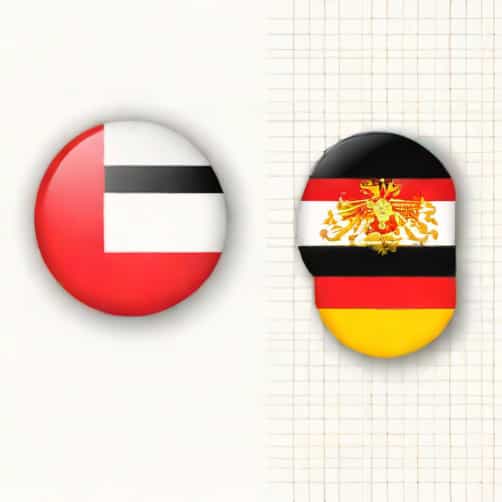
The difference between Austrian and German people, cultures, and even their versions of the German language is a topic that often sparks curiosity among travelers and language learners. While both Austria and Germany share a common linguistic and historical background, they have developed distinct identities over the centuries. From pronunciation and vocabulary differences in the language to variations in traditions, food, and social habits, the Austrian and German ways of life showcase the diversity that exists within the German-speaking world.
Historical Background
To understand the difference between Austrian and German cultures, it is important to look back at their shared history. Both regions were once part of the Holy Roman Empire, and German was a common language used across many territories. However, Austria developed its own political and cultural trajectory, especially under the Habsburg Empire, which ruled vast areas of Central and Eastern Europe. Meanwhile, Germany unified much later in the 19th century under Prussian leadership.
Austria’s past as a multiethnic empire gave it a unique cultural flavor, with influences from Italy, Hungary, the Czech lands, and the Balkans. Germany, on the other hand, evolved as a powerful industrial and political force, particularly after its unification in 1871. These different historical paths led to variations in how Austrians and Germans perceive themselves and their culture.
Language Differences Austrian German vs. Standard German
Although Austrians and Germans both speak German, there are noticeable linguistic differences between the two. Austrian German, known as Österreichisches Deutsch, is one of the recognized varieties of the German language. It is mutually intelligible with the standard German used in Germany, but pronunciation, vocabulary, and some grammar can differ.
Pronunciation and Accent
The Austrian accent is generally considered softer and more melodic than the German accent, which can sound sharper or more clipped to foreign ears. For example, Austrians often elongate vowels and speak in a smoother rhythm, while Germans tend to articulate consonants more distinctly.
Vocabulary Variations
Many words that Austrians use daily are not common in Germany. These differences can be compared to the variations between British and American English. For instance
- German (Germany)Brötchen– AustrianSemmel(bread roll)
- GermanSahne– AustrianObers(cream)
- GermanTomate– AustrianParadeiser(tomato)
- GermanKartoffel– AustrianErdapfel(potato)
These differences are not only linguistic but also reflect regional traditions and cuisine. Despite this, both Austrians and Germans understand each other quite easily, though they might smile at certain unfamiliar words.
Formal Language and Politeness
Austrians are known for being slightly more formal and polite in their communication. For example, while Germans might quickly move to using the informal du, Austrians often continue to use the polite Sie for a longer time, especially in professional or social settings. This reflects the Austrian cultural emphasis on courtesy and respect.
Cultural and Social Differences
Beyond language, the cultural differences between Austria and Germany are visible in daily life, traditions, and attitudes. Although they share many values, such as efficiency and love of order, each country has its own unique cultural atmosphere.
Social Behavior and Attitudes
Germans are often described as direct, straightforward, and pragmatic. They value punctuality, structure, and clarity in communication. Austrians, while also organized and precise, tend to have a more relaxed and diplomatic manner. Their humor is subtler, and they often use irony or understatement in conversation.
In social settings, Austrians are also more likely to engage in small talk and maintain a sense of charm or grace in their interactions. Germans, on the other hand, may appear more serious or formal, though they are equally friendly once relationships develop.
Differences in Food and Cuisine
The difference between Austrian and German food is another way their cultures can be distinguished. While both enjoy hearty, meat-based dishes and rich desserts, Austria’s cuisine has more Mediterranean and Eastern European influences due to its imperial history.
- Austrian CuisineKnown for famous dishes such as Wiener Schnitzel, Tafelspitz, and Apfelstrudel, Austrian food reflects a blend of flavors from the former Austro-Hungarian Empire.
- German CuisineFocused more on sausages, bread, potatoes, and sauerkraut. Each region in Germany, such as Bavaria or Saxony, has its own specialties.
Coffee culture is also more prominent in Austria, especially in Vienna, where coffeehouses are cultural institutions. Germans tend to prefer beer as a social beverage, while Austrians enjoy both beer and wine, particularly from their local vineyards.
Festivals and Traditions
Austria and Germany share many traditional festivals, such as Christmas markets and Easter celebrations, but each has its own unique style. For instance, while Germany’s Oktoberfest in Munich is globally famous, Austria has similar yet smaller-scale beer and wine festivals that reflect its local culture.
Vienna, the capital of Austria, is known for its classical music heritage, opera houses, and elegant balls, which showcase the country’s long association with art and refinement. Germany, meanwhile, is renowned for its technological exhibitions, modern art scenes, and lively carnival traditions, particularly in Cologne.
Geographical and Lifestyle Differences
Geographically, Austria is a landlocked country dominated by the Alps, giving it a landscape filled with mountains, lakes, and scenic valleys. Outdoor activities such as skiing, hiking, and mountaineering are integral parts of Austrian life. Germany has more diverse geography, ranging from the Bavarian Alps in the south to the North Sea coastline in the north, allowing for a variety of lifestyles and regional cultures.
Urban life in Austria tends to be slower-paced compared to Germany’s bustling metropolitan centers like Berlin, Hamburg, or Munich. Vienna is elegant and historically rich, while German cities often showcase a mix of modern industry and cultural heritage.
Economic and Political Perspectives
Germany is the largest economy in Europe and a global industrial powerhouse, known for its automotive and manufacturing sectors. Austria, though smaller, has a strong economy based on tourism, banking, and high-quality craftsmanship. Politically, both countries are democratic republics, but Austria is a neutral state with no NATO membership, reflecting its post-World War II policy of neutrality.
Education and Work Culture
Work culture also differs subtly. Germans are typically known for their efficiency, precision, and focus on productivity. Austrians share these traits but tend to place more emphasis on work-life balance. The Austrian approach to work often incorporates a touch of leisure and appreciation for cultural activities.
While Austria and Germany share the German language and many cultural similarities, their differences lie in nuances of expression, lifestyle, and history. The difference between Austrian and German people can be seen in the softer tone of Austrian German, the formal politeness in their social interactions, and the diverse cultural influences that shape Austrian life. Germany, with its vast regions and industrial power, represents a more modern, direct, and pragmatic culture.
Both nations embody the richness of the German-speaking world in unique ways. Understanding the difference between Austrian and German identity allows travelers, language learners, and cultural enthusiasts to appreciate how history, geography, and tradition have shaped these two fascinating countries. Whether one is enjoying a coffee in Vienna or a beer in Munich, both cultures offer depth, charm, and a shared yet distinct European spirit.