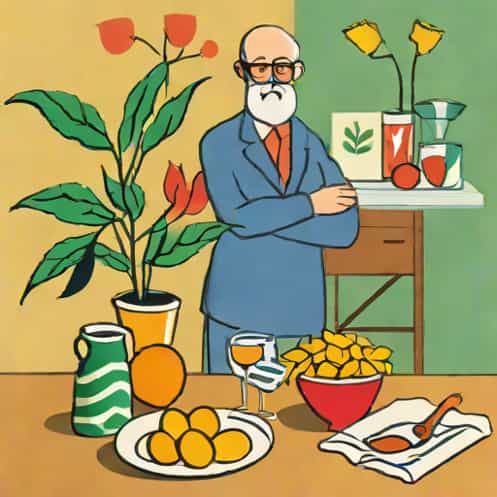
Henri Matisse is widely regarded as one of the most influential artists of the 20th century, celebrated for his vibrant use of color, innovative techniques, and significant contributions to modern art. Born in 1869 in Le Cateau-Cambrésis, France, Matisse initially studied law before discovering a passion for painting that would define his life. His works span a variety of styles, including painting, sculpture, printmaking, and collage, reflecting a relentless pursuit of beauty and artistic expression. Matisse’s career was marked by experimentation, bold choices in color, and a dedication to capturing emotion and harmony in his compositions, making him a central figure in the Fauvist movement and modern art history.
Early Life and Education
Henri Matisse was born on December 31, 1869, to a family involved in the grain trade. His early education was in law, and he initially pursued a legal career. However, after an illness during his early twenties, Matisse began painting while recovering, discovering a natural talent and deep passion for art. He enrolled at the Académie Julian in Paris and later studied under renowned painter Gustave Moreau at the Ãcole des Beaux-Arts. This formal training provided Matisse with a solid foundation in traditional techniques while also encouraging him to explore his unique artistic voice.
Fauvism and Artistic Style
Matisse is best known for his role in the Fauvist movement, which emerged in the early 1900s. Fauvism is characterized by bold, non-naturalistic colors, simplified forms, and expressive brushwork. Matisse’s paintings from this period, such as Woman with a Hat (1905), shocked the art world with their vibrant and unconventional use of color. Fauvism was not about realistic representation but rather about conveying emotion through color and form. Matisse’s approach emphasized harmony and balance, combining strong visual impact with aesthetic elegance.
Major Works
Henri Matisse produced a vast body of work throughout his long career. His paintings, drawings, sculptures, and later paper cutouts demonstrate his continual experimentation and evolving style. Some of his most famous works include
- The Dance(1910) A large-scale painting showcasing human figures in motion, emphasizing rhythm and energy through vibrant colors.
- Woman with a Hat(1905) A Fauvist masterpiece demonstrating Matisse’s bold use of color and expressive portraiture.
- Red Studio(1911) A painting exploring spatial relationships and color contrasts within a domestic interior.
- Jazz(1947) A collection of colorful paper cutouts that highlight Matisse’s innovative approach later in life.
- Blue Nude(1907) A work demonstrating Matisse’s experimentation with simplified forms and expressive line work.
Techniques and Innovations
Matisse was a pioneer in many artistic techniques. While he began with traditional oil painting, he later embraced paper cutouts, a method he called painting with scissors, creating dynamic compositions from colored paper. He also experimented with printmaking, sculpture, and decorative arts. Matisse’s work is characterized by flat planes of color, fluid lines, and simplified forms that emphasize the overall composition rather than realistic detail. His innovative use of color, pattern, and abstraction has influenced countless artists and continues to be studied and admired today.
Impact on Modern Art
Henri Matisse’s influence on modern art is profound. His fearless approach to color and form challenged conventional ideas of representation and paved the way for future abstract and expressionist movements. Matisse’s philosophy that art should be a source of joy, beauty, and emotional resonance inspired generations of artists. Alongside Pablo Picasso, Matisse defined early 20th-century modernism and helped establish Paris as the center of avant-garde art. His works are widely exhibited in museums around the world, including the Museum of Modern Art in New York and the Centre Pompidou in Paris.
Personal Life
Matisse married Amélie Noellie Parayre in 1898, and the couple had three children. Despite facing health challenges later in life, including a serious illness in his seventies that limited his mobility, Matisse continued to create art using his innovative cutout technique. His dedication to his craft, even during times of personal struggle, reflects his deep commitment to artistic expression. Matisse maintained a warm, approachable personality and was known for his generosity in mentoring younger artists.
Later Years and Legacy
In his later years, Matisse focused on large-scale cutouts, producing some of his most iconic and colorful works. Projects like the Chapelle du Rosaire de Vence, a chapel in southern France, showcase his mastery of color, light, and spatial composition. Matisse passed away in 1954 at the age of 84, leaving behind a legacy that transformed modern art. His work continues to be celebrated for its innovation, beauty, and emotional resonance, influencing painters, designers, and visual artists across disciplines.
Interesting Facts About Henri Matisse
- Matisse initially studied law and only turned to art after an illness during his early twenties.
- He was a leading figure in the Fauvist movement, which emphasized bold color and expressive brushwork.
- Matisse often experimented with multiple mediums, including painting, sculpture, printmaking, and paper cutouts.
- His painting with scissors technique allowed him to continue creating art even when physically limited.
- The Chapelle du Rosaire de Vence in France is one of Matisse’s most significant architectural and decorative works.
- Matisse’s works are held in major museums worldwide and continue to influence contemporary art.
Henri Matisse’s life and work represent a journey of continuous exploration and innovation in art. From his early Fauvist paintings to his later paper cutouts, Matisse consistently challenged traditional ideas about color, form, and composition. His dedication to creating beauty and joy through art has left a lasting mark on modern art and continues to inspire artists today. By embracing experimentation, emotional expression, and bold creativity, Matisse demonstrated that art is not just a visual experience but a celebration of life, color, and human imagination. His legacy endures as one of the most significant in the history of art, reminding us of the transformative power of creativity.