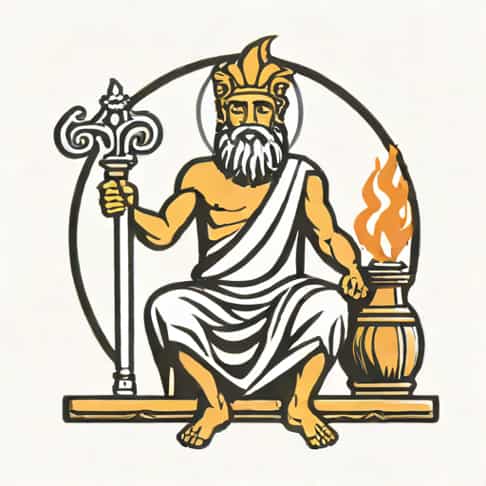
In ancient Greek mythology, the world of gods was not only about beauty, power, and war, but also about craftsmanship, labor, and creative fire. Among the Olympian gods, one figure stands out as the divine representation of skill, invention, and the transforming power of flame. The Greek god of fire and blacksmiths is a fascinating character because he reflects both divine strength and human struggle. His story connects fire with creativity, endurance, and the ability to shape raw materials into objects of lasting value.
The Identity of the Greek God of Fire and Blacksmiths
The Greek god of fire and blacksmiths is Hephaestus. Hephaestus was known as the god of fire, metalworking, craftsmanship, and artisans. Unlike many other Greek gods who embodied physical perfection, Hephaestus was often described as lame or physically imperfect.
This contrast made him unique among the Olympians. While other gods ruled through beauty or brute force, Hephaestus ruled through skill, intelligence, and persistence. His association with fire was not destructive like lightning or war, but creative and controlled.
Fire as a Symbol of Creation
In Greek mythology, fire was a powerful symbol. For Hephaestus, fire represented transformation. It was the force that allowed raw metal to become tools, weapons, and works of art.
As the god of fire and blacksmiths, Hephaestus used flame to shape the physical world. His fire was the heat of the forge, not the chaos of wildfire. This made him a symbol of constructive power rather than destruction.
The Forge and the Workshop
Hephaestus was said to work in vast forges, often imagined beneath volcanoes. These fiery workshops were filled with anvils, hammers, and molten metal.
Volcanoes themselves were believed to be signs of his presence, with eruptions representing the intense activity of his forge deep below the earth.
Hephaestus Among the Olympian Gods
Hephaestus held an important place on Mount Olympus, even though his relationships with other gods were often complicated. In some myths, he was cast out of Olympus as a child, either by Hera or Zeus, because of his physical condition.
Despite this rejection, Hephaestus returned and proved his worth through his unmatched craftsmanship. His story reflects themes of resilience and redemption.
A God Respected for Skill
Even gods who mocked or underestimated Hephaestus relied on his abilities. He created weapons, armor, and magical objects that no other god could make.
His skill earned him respect, even when his appearance did not match the idealized image of divinity.
Masterpieces Forged by the God of Blacksmiths
Hephaestus was credited with creating many legendary items in Greek mythology. These objects were not only powerful but also beautifully crafted.
- The armor of Achilles, forged with divine precision
- The shield of Achilles, depicting scenes of human life
- Zeus’s thunderbolts
- Golden automata that assisted him in his workshop
Each creation demonstrated the connection between fire, skill, and imagination.
The Role of Hephaestus in Human Life
Unlike some gods who were distant or feared, Hephaestus was closely associated with human artisans. Blacksmiths, sculptors, and craftsmen saw him as their divine patron.
He represented the dignity of labor and the value of skill developed through effort. In this way, the Greek god of fire and blacksmiths bridged the gap between gods and mortals.
Craftsmanship as a Sacred Act
To honor Hephaestus, craftsmanship itself was seen as a sacred activity. Working with fire and metal required patience, precision, and respect for powerful forces.
This perspective elevated manual labor to something worthy of divine recognition.
Fire, Technology, and Progress
Hephaestus can also be seen as a symbol of early technology. Fire allowed humans to cook food, shape tools, and build civilizations.
As the god of fire and blacksmiths, Hephaestus represented innovation and progress. His myths reflect an ancient understanding that technology, when guided by wisdom, can improve life.
Relationships and Personal Struggles
Hephaestus’s personal life was marked by difficulty. He was married to Aphrodite, the goddess of love and beauty, but their relationship was troubled.
These stories often highlight emotional pain, jealousy, and betrayal, making Hephaestus one of the most relatable gods in Greek mythology.
A God Who Understood Suffering
Because of his experiences with rejection and hardship, Hephaestus is often viewed as a god who understood suffering. His myths suggest that creativity can emerge from pain.
This aspect of his character adds emotional depth to his role as the god of fire and blacksmiths.
Festivals and Worship of Hephaestus
In ancient Greece, Hephaestus was honored through festivals and temples, especially in cities known for craftsmanship and industry.
Athens, in particular, held him in high regard, recognizing the importance of skilled labor in civic life.
The Cultural Importance of the Blacksmith
Blacksmiths were essential figures in ancient societies. They created tools, weapons, and infrastructure.
By worshiping Hephaestus, communities acknowledged the importance of those who worked with fire and metal.
Hephaestus in Art and Literature
Ancient artists often depicted Hephaestus with tools such as a hammer or tongs, emphasizing his identity as a working god.
Literary works portrayed him as clever, determined, and inventive, reinforcing the idea that intelligence and skill are powerful forms of strength.
The Legacy of the Greek God of Fire and Blacksmiths
Today, Hephaestus remains a powerful symbol of creativity, resilience, and craftsmanship. His myths continue to influence art, literature, and modern interpretations of mythological figures.
The image of the god at the forge, shaping metal with fire, still resonates as a metaphor for human creativity and perseverance.
Why Hephaestus Still Matters
The story of the Greek god of fire and blacksmiths speaks to anyone who has felt underestimated or overlooked. Hephaestus proves that value is not determined by appearance, but by contribution and character.
His mastery of fire reminds us that powerful forces can be used to build, not destroy, when guided by skill and purpose.
Hephaestus, the Greek god of fire and blacksmiths, represents the creative heart of ancient mythology. Through fire, he transformed raw materials into objects of beauty and power. Through persistence, he transformed rejection into respect.
His legacy endures as a reminder that craftsmanship, innovation, and resilience are timeless virtues. In the glowing forge of Hephaestus, fire becomes more than heat-it becomes the spark of creation itself.