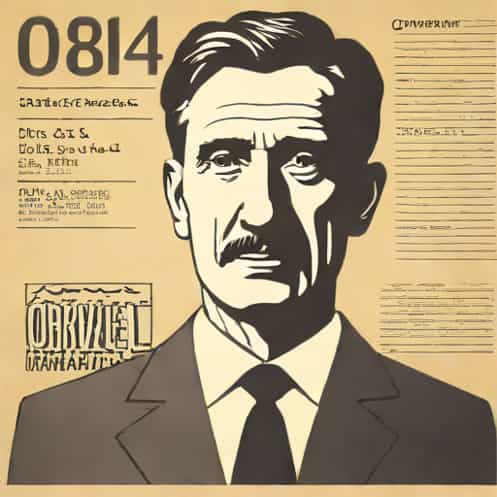
George Orwell’s novel1984has become one of the most powerful and influential works of modern literature, shaping the way people think about government, surveillance, freedom, and truth. Readers often wonder how Orwell was able to write such a chilling and prophetic story. The process of writing1984was not easy for him, and it reflected his personal struggles, political observations, and unique writing style. Understanding how Orwell wrote1984means exploring the circumstances of his life, the inspirations he drew from history, and the painstaking effort he put into crafting a novel that still resonates decades after its publication.
Orwell’s Personal Circumstances
When George Orwell began working on1984, he was living in difficult conditions. He moved to the Isle of Jura, a remote and rugged island in Scotland, in 1946. Orwell chose this location for its isolation, which he hoped would allow him to focus fully on his writing. However, the conditions were harsh, and his health was already fragile due to tuberculosis. Despite his illness, he pressed forward, determined to complete what would become his most famous work.
Writing in Jura was not glamorous. Orwell lived in a farmhouse without modern conveniences, and the weather was often cold and damp. Yet the isolation also gave him the concentration he needed. His personal battle with illness and physical discomfort shaped the bleak and oppressive mood of the novel, making the world of1984feel even more authentic.
Historical Influences on 1984
To understand how Orwell wrote1984, it is essential to recognize the historical context that influenced him. Orwell lived through turbulent times World War II, the rise of fascism, and the expansion of Soviet communism all played a role in shaping his worldview.
Totalitarian Regimes
Orwell had observed the dangers of totalitarian governments firsthand. He fought in the Spanish Civil War, where he witnessed political betrayals and propaganda used to control public perception. Later, he closely watched the rise of Stalin’s Soviet Union, Hitler’s Nazi regime, and Mussolini’s fascist Italy. These governments relied on censorship, surveillance, and control of truth, all of which became central themes in1984.
The Post-War Atmosphere
After World War II, the world was divided between superpowers, and the Cold War was beginning. The atmosphere of suspicion, espionage, and fear of global conflict contributed to Orwell’s imagination of a dystopian future. He took elements from the present and exaggerated them to create the world of Big Brother, the Thought Police, and a society where individuality was crushed.
The Writing Process
Orwell was meticulous in his writing process, and1984went through several drafts before reaching its final form. His approach to writing combined discipline, careful observation, and a deep concern with language and truth.
Drafting and Revisions
Orwell began the first draft of1984in 1947. His illness made it a slow and exhausting process, but he was determined to finish. He worked long hours, revising extensively to sharpen the novel’s message. Reports suggest that he typed the manuscript himself, often reworking entire sections to get the tone and detail just right. By 1948, he had completed a nearly finished draft, which he continued editing until its publication in 1949.
The Importance of Language
One of Orwell’s main obsessions was language, and this is reflected in the invention of Newspeak within the novel. In his earlier essay Politics and the English Language, Orwell had criticized the way governments and institutions manipulate words to hide the truth. While writing1984, he developed Newspeak as a fictional example of how language could be weaponized to control thought. This shows how his nonfiction ideas about writing were directly tied to the novel’s creation.
The Themes He Developed While Writing
During the process of writing, Orwell refined the themes that make1984so enduring. These themes did not appear suddenly but grew out of years of observation and personal reflection.
- SurveillanceThe idea of a government constantly watching its citizens was inspired by wartime intelligence operations and authoritarian states.
- Truth and PropagandaOrwell developed the Ministry of Truth based on his observations of propaganda used in both democratic and totalitarian states.
- Totalitarian PowerThe novel shows how absolute control over individuals leads to the destruction of freedom and humanity.
- Psychological ManipulationOrwell was fascinated by how fear and indoctrination could force people to accept lies as reality.
Challenges Orwell Faced While Writing
Writing1984was not an easy journey for Orwell. He faced multiple challenges, both personal and creative. His health was deteriorating rapidly due to tuberculosis, which caused him pain and exhaustion. At times, he was bedridden, yet he continued to write, typing in bed or dictating notes. This relentless determination is part of what makes1984such a remarkable achievement.
Another challenge was capturing the right balance between fiction and political commentary. Orwell wanted the novel to be a work of art as well as a warning about the future. He revised carefully to ensure that the story was compelling, not just didactic. This struggle between storytelling and political critique shaped the final version of the novel into a masterpiece.
Publication of 1984
When Orwell finally finished the manuscript, it was published in June 1949. By this time, his health had worsened, and he would die less than a year later in January 1950. Despite his illness, he lived to see the book’s initial reception. The novel immediately drew attention for its stark portrayal of a dystopian future, and critics recognized its importance as a political and literary achievement.
Why Orwell’s Writing Stands Out
Orwell’s ability to write1984with such precision and foresight comes from his unique qualities as a writer. He combined journalistic clarity with imaginative storytelling, creating a novel that feels both realistic and timeless. His commitment to truth, even when it was uncomfortable, gave his writing an authenticity that continues to resonate today.
Clarity and Simplicity
Unlike many writers of his time, Orwell favored clear, direct language. He believed that complicated or vague writing was a tool of manipulation. This style made1984accessible to a wide audience while still delivering profound ideas.
Personal Conviction
Orwell’s deep moral commitment to exposing lies and fighting for truth was central to his writing.1984was not just a story but a warning to future generations. His sincerity and urgency come through in every page of the novel.
Legacy of Orwell’s Writing Process
The way Orwell wrote1984is a reminder of the power of persistence and the importance of ideas. Despite poor health and isolation, he produced a novel that continues to influence literature, politics, and culture. His writing process demonstrates that great works are often born out of personal struggle and dedication.
George Orwell wrote1984under difficult circumstances, balancing his deteriorating health with the desire to warn the world about the dangers of totalitarianism, surveillance, and the manipulation of truth. He drew from history, personal experience, and his own essays on language to craft a novel that remains one of the most significant works of the 20th century. By writing with clarity, conviction, and discipline, Orwell created a story that transcends its time. Understanding how Orwell wrote1984shows not only his genius but also the enduring relevance of his vision in today’s world, where questions about freedom and truth are as urgent as ever.