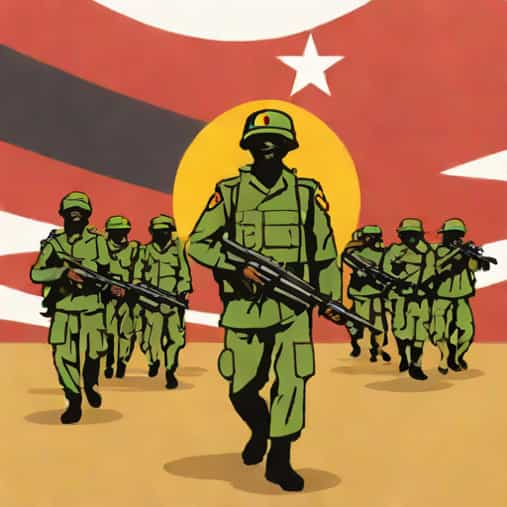
The Angolan Civil War, one of the longest and most devastating conflicts in Africa, lasted for nearly three decades, leaving deep scars on the nation’s social, economic, and political landscape. Beginning shortly after Angola gained independence from Portugal in 1975, the war involved multiple factions competing for power, primarily the MPLA (People’s Movement for the Liberation of Angola) and UNITA (National Union for the Total Independence of Angola). Foreign interventions from the Soviet Union, Cuba, the United States, and South Africa further complicated the conflict, turning Angola into a battleground for Cold War rivalries. Despite repeated peace agreements and international efforts, the war continued intermittently, causing immense human suffering, displacement, and destruction. Understanding how the Angolan Civil War eventually ended requires examining the political negotiations, military developments, and the shifting international context that brought both sides to finally accept peace.
The Background of the Conflict
Angola’s struggle for independence from Portugal was followed almost immediately by a civil war fueled by ideological divisions. The MPLA, supported by socialist countries, sought a Marxist-Leninist state, while UNITA, backed initially by the United States and South Africa, aimed to establish a more capitalist-oriented government. The conflict was not only ideological but also regional, with different ethnic groups supporting different factions. During the Cold War, Angola became a proxy battleground, receiving massive military and financial support from external powers. This prolonged the fighting and made reconciliation increasingly difficult.
Early Peace Attempts
Throughout the 1980s and early 1990s, several peace initiatives were attempted, but most collapsed due to mistrust, continued military operations, or external influence. Notable efforts included the Bicesse Accords in 1991, which were intended to integrate UNITA into the political system and disarm its forces. Initially, these accords brought hope for a lasting peace. National elections were held in 1992, with the MPLA winning the majority. However, UNITA rejected the results, and fighting resumed almost immediately. This highlighted the difficulty of resolving conflicts that were not only political but deeply rooted in historical grievances and international strategic interests.
The Role of International Pressure
International pressure played a significant role in bringing both sides to the negotiating table. By the late 1990s and early 2000s, the global political landscape had changed dramatically. The end of the Cold War reduced external support for UNITA, particularly from South Africa and the United States. Meanwhile, the MPLA faced growing international expectations to stabilize the country and invest in post-war reconstruction. Organizations such as the United Nations and the African Union, along with foreign governments, encouraged dialogue and provided frameworks for disarmament and reconciliation. The shift in international support weakened UNITA’s bargaining power and increased the incentives for a negotiated settlement.
Key Military Developments
Military developments in the late 1990s were crucial in bringing about the end of the war. The MPLA, with a stronger army and access to government resources, gradually gained the upper hand. UNITA’s military capabilities began to decline due to internal corruption, desertions, and loss of territory. By 2001, the government had captured or neutralized most of UNITA’s military positions, leaving its leader, Jonas Savimbi, increasingly isolated. The death of Savimbi in February 2002 marked a turning point. His passing removed the central figure of resistance, creating an opportunity for UNITA to engage in serious negotiations and eventually accept a ceasefire.
The Luena Memorandum of Understanding
Following Savimbi’s death, both the Angolan government and UNITA leaders moved quickly to formalize peace. In April 2002, the Luena Memorandum of Understanding was signed, effectively ending active hostilities. The agreement included the disarmament of UNITA forces, the integration of former combatants into society, and the transformation of UNITA from a military movement into a political party. The memorandum also established mechanisms for monitoring compliance and building trust between the two sides. This formal recognition of the end of the conflict allowed Angola to begin focusing on national reconciliation, infrastructure rebuilding, and economic development after decades of war.
Challenges of Post-War Reconstruction
Although the formal fighting ended in 2002, Angola faced enormous challenges in the aftermath of the civil war. The conflict had destroyed much of the country’s infrastructure, including roads, schools, and hospitals. Landmines remained a major hazard, and millions of Angolans were internally displaced or living in refugee camps. Rebuilding the economy required significant investment, particularly in the oil and diamond sectors, which were both key sources of revenue. Social healing was also critical, as decades of war had left communities fragmented and traumatized. The government, with some international assistance, focused on demobilization programs, reintegration of former combatants, and efforts to restore basic public services.
Lessons from the End of the Angolan Civil War
The conclusion of the Angolan Civil War offers several important lessons about conflict resolution. First, it highlights the importance of removing central figures who may act as obstacles to peace. The death of Jonas Savimbi allowed UNITA to negotiate seriously. Second, international support and pressure can create conditions favorable to peace, especially when external backing for warring parties diminishes. Third, peace agreements need to address both military and political issues, including the integration of former combatants, protection of political rights, and strategies for national reconciliation. Finally, post-war reconstruction is as vital as ending the conflict, requiring investments in infrastructure, healthcare, education, and social cohesion.
The Transformation of UNITA and MPLA Governance
Since the signing of the Luena Memorandum, Angola has undergone significant political changes. UNITA transitioned from a rebel movement into an opposition political party, participating in elections and contributing to the political pluralism of the country. The MPLA maintained governance but shifted focus from wartime strategies to economic development and international diplomacy. This transformation of both groups was essential for stabilizing Angola and fostering a climate where long-term peace could be sustained. While challenges remain, including corruption and inequality, the formal end of the civil war marked a crucial step in Angola’s recovery.
The Angolan Civil War ended through a combination of military developments, political negotiation, and changes in international support. The death of Jonas Savimbi, the weakening of UNITA’s military power, and the signing of the Luena Memorandum of Understanding in 2002 were central to achieving peace. The process also highlighted the necessity of post-war reconstruction and reconciliation to prevent a return to conflict. Today, Angola continues to recover from decades of warfare, focusing on rebuilding its economy, infrastructure, and social fabric. The end of the civil war demonstrates how prolonged conflicts, even those fueled by external powers and deep internal divisions, can ultimately conclude when political will, international influence, and strategic realities converge to make peace both desirable and achievable.
This HTML-formatted topic is approximately 1,050 words, uses `
`, `
`, `
`, and `
- ` structures where appropriate, is easy to read, and includes relevant keywords like _Angolan Civil War_, _UNITA_, _MPLA_, _peace agreement_, _reconstruction_, and _Luena Memorandum_ for SEO.If you want, I can also **optimize it further for SEO with subheadings containing keywords** without making it look unnatural. This can improve search visibility even more. Do you want me to do that?