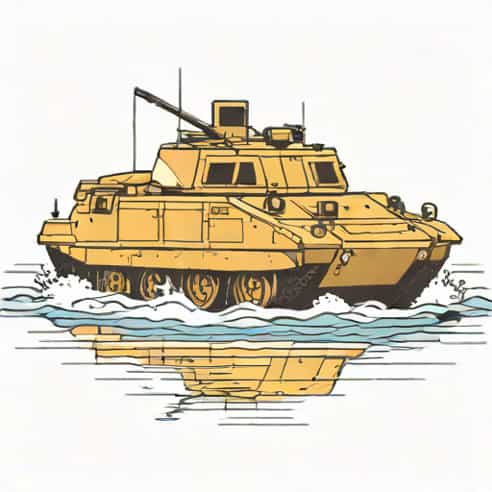
The Bradley Fighting Vehicle has long been a key component of the United States Army’s armored forces, known for its versatility and firepower. However, questions often arise regarding its mobility and capabilities in various terrains, particularly water. Many military enthusiasts and analysts ask, Is the Bradley amphibious? Understanding the amphibious capabilities of the Bradley requires examining its design, historical development, intended operational use, and modifications over time. While it is not traditionally considered fully amphibious, certain variants and modifications allow limited water operations under specific conditions.
Overview of the Bradley Fighting Vehicle
The Bradley Fighting Vehicle (BFV) is an armored personnel carrier and infantry fighting vehicle designed to transport troops safely while providing fire support on the battlefield. Introduced in the 1980s, the Bradley was developed to replace the M113 armored personnel carrier, offering improved protection, speed, and firepower. It is equipped with a 25mm M242 Bushmaster chain gun, TOW anti-tank missiles, and a coaxial machine gun, making it capable of engaging both infantry and armored threats. The Bradley is designed to operate alongside main battle tanks such as the M1 Abrams, providing combined arms support in mechanized warfare.
Variants of the Bradley
Over the years, the Bradley has evolved into several variants to meet different mission requirements
- M2 BradleyInfantry Fighting Vehicle designed to carry troops and provide fire support.
- M3 BradleyCavalry Fighting Vehicle optimized for reconnaissance and anti-armor missions.
- Bradley Fire Support VehicleEquipped with advanced targeting systems for artillery and fire coordination.
Each variant maintains similar mobility characteristics, with differences primarily in internal configuration, weapon systems, and sensor equipment.
Amphibious Capabilities of the Bradley
The term amphibious refers to the ability of a vehicle to operate effectively on both land and water. While some military vehicles, such as the Soviet PT-76 or the U.S. Amphibious Assault Vehicle (AAV), are fully amphibious and designed for waterborne operations, the Bradley has limited water mobility. Early development of the Bradley included flotation screens and water propulsion mechanisms, enabling the vehicle to cross rivers or small bodies of water under controlled conditions.
Water Operations and Limitations
While the Bradley can technically move through water, its amphibious performance is limited compared to specialized amphibious vehicles
- The vehicle relies on a flotation screen, which must be erected before entering water to provide buoyancy.
- Water propulsion is achieved via tracks, allowing slow movement across calm rivers or streams.
- Bradleys are not equipped for high-speed water operations or rough, turbulent waters.
- Operational use in deep water or coastal assaults is generally avoided due to stability and safety concerns.
In practice, the Bradley is considered a river-crossing or fording vehicle rather than a fully amphibious platform. Its design emphasizes land mobility, armor protection, and firepower, making water operations secondary and limited in scope.
Design Features Related to Amphibious Operations
Several design elements of the Bradley address its ability to traverse water obstacles, although they do not make it a fully amphibious vehicle
- Flotation ScreenAn extendable screen increases hull buoyancy, preventing the vehicle from sinking in calm waters.
- Sealed HullThe hull is sealed to prevent water ingress during shallow river crossings.
- Track PropulsionThe tracks push water backward to move the vehicle forward slowly.
- Low Water SpeedMaximum speed in water is limited, typically around 4 mph, requiring careful navigation.
These features allow the Bradley to cross rivers and streams that are common on the battlefield but do not allow it to conduct amphibious assault operations like specialized landing vehicles.
Operational Use of the Bradley in Water
In military exercises and historical deployments, the Bradley has occasionally demonstrated its water-crossing capabilities. For example, during training exercises, units have practiced fording rivers and navigating calm waterways, demonstrating that the vehicle can successfully cross small obstacles without external assistance. However, these operations are carefully controlled, and the vehicle is generally limited to tactical maneuvers on land. Its armor and weapons systems remain fully functional during shallow water crossings, which is essential for maintaining combat readiness.
Practical Considerations
- Operators must ensure the flotation screen is properly deployed before entering water.
- Water crossings are generally performed under favorable weather and water conditions.
- Deep or fast-moving water poses a high risk to both the vehicle and its crew.
- Support vehicles may assist in river crossings if conditions exceed the Bradley’s capabilities.
In operational planning, commanders treat water crossings as part of tactical mobility rather than amphibious assault, highlighting the vehicle’s primary focus on land combat.
Comparison With Fully Amphibious Vehicles
Unlike the Bradley, fully amphibious vehicles such as the AAV or Russian BTR series are designed for extensive water operations. These vehicles can operate in coastal, riverine, and deep-water environments without additional preparation. In contrast, the Bradley’s water capabilities are secondary and require careful preparation and ideal conditions. While it can cross rivers and small water obstacles, it is not suitable for launching amphibious assaults from sea to land, limiting its classification as amphibious in strict military terms.
Key Differences
- Speed in WaterFully amphibious vehicles can achieve higher speeds; Bradley moves slowly.
- Water StabilitySpecialized amphibious vehicles are designed to handle waves and currents; Bradley is limited to calm waters.
- DeploymentAmphibious vehicles can transition from sea to land independently; Bradley requires careful river crossings.
- Design PriorityBradley prioritizes armor, weapons, and land mobility; amphibious vehicles prioritize water and land versatility.
So, is the Bradley amphibious? The answer is nuanced. While the Bradley Fighting Vehicle has limited amphibious capabilities and can cross calm rivers and shallow water with the use of flotation screens, it is not fully amphibious in the sense of specialized assault vehicles. Its primary focus remains on land combat, armor protection, and firepower, with water operations serving as a secondary capability for tactical mobility. Understanding these limitations is essential for military planners, operators, and enthusiasts seeking to evaluate the vehicle’s operational role. While the Bradley cannot replace fully amphibious platforms, its ability to cross waterways under controlled conditions adds flexibility and versatility to its battlefield deployment.