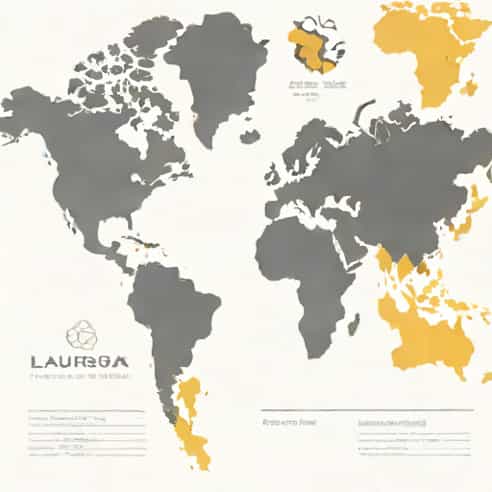
Long before today’s continents took their familiar shapes, the Earth looked completely different. Massive landmasses were combined into supercontinents that shifted, collided, and separated over millions of years. One of these ancient formations, known as Laurasia, played a major role in shaping the geography we recognize today. Understanding which two continents formed Laurasia helps explain the long geological journey that created modern landscapes. This topic remains fascinating because it connects prehistoric Earth to the continents we live on now, revealing how land, climate, and ecosystems evolved over deep time.
The Ancient Supercontinent Laurasia
Laurasia was one of the two major supercontinents that emerged when the massive Pangaea began to break apart about 200 million years ago. While the southern half became Gondwana, the northern half transformed into Laurasia. This supercontinent consisted of regions that would eventually become several modern continents. Yet at the core of Laurasia were two major continental plates that acted as its foundation.
Name Two Continents That Formed Laurasia
The two primary continents that formed Laurasia were North America and Eurasia. These landmasses were connected during prehistoric times, forming a broad northern supercontinent. Over time, tectonic activity separated them gradually, but their shared origin explains certain similarities in geology, fossil records, and ancient mountain ranges.
- North America
- Eurasia (which includes Europe and Asia)
These two regions were not shaped exactly as we know them today, but their prehistoric versions served as the backbone of Laurasia’s structure.
North America’s Role in Laurasia
North America was a major component of Laurasia, positioned on the western side of the supercontinent. Its ancient geological formations were connected to areas that now form parts of Europe and Greenland. The landmass itself was part of a larger plate known as the Laurentian or North American Plate.
Geological Features Linked to Laurasia
North America still bears signs of its ancient connection to other continents. Mountain ranges, rock layers, and fossil sites show evidence of a time when North America was not isolated.
- The Appalachian Mountains contain rocks that match those found in Scotland and Norway.
- Fossil distributions from Laurasian species stretch across both sides of the Atlantic.
- Plate movements slowly carried North America westward, separating it from Eurasia.
These clues help scientists reconstruct Earth’s geological history and confirm the connection between the continents that formed Laurasia.
Eurasia’s Importance in Laurasia
Eurasia, the vast landmass that includes Europe and Asia, formed the eastern portion of Laurasia. Instead of being separate continents during prehistoric times, they existed as a unified plate known as the Eurasian Plate. This plate shared mountain belts, ecosystems, and land bridges with ancient North America.
Connections With North America
The link between Eurasia and North America was not merely geographical it was biological and ecological as well. Throughout geological history, animals and plants migrated between the continents using land bridges that formed during various ice ages.
- The Bering Land Bridge connected Siberia and Alaska.
- Early mammals spread across both regions during the Cenozoic Era.
- Similar fossils have been found on both continents, confirming their ancient unity.
These links demonstrate how the continents that formed Laurasia shaped the development of species and environments long before humans appeared.
How Laurasia Formed From Pangaea
Understanding the process behind Laurasia’s formation helps illustrate how continents drift over millions of years. When Pangaea existed, all continents were fused into one giant landmass. Around 200 million years ago, tectonic activity began to slowly tear Pangaea apart.
The Split Into Two Supercontinents
The breakup resulted in two major supercontinents
- Laurasia in the north
- Gondwana in the south
Laurasia’s structure was dominated by the North American and Eurasian plates, accompanied by smaller fragments that later contributed to climates, ecosystems, and ocean patterns.
Continental Drift and Plate Tectonics
Continental drift explains how Laurasia eventually separated into the continents we know today. The process is slow, with plates moving only a few centimeters each year, but over millions of years, this movement shapes the entire planet.
- The Atlantic Ocean widened as North America moved away from Eurasia.
- The Himalayas formed as India collided with Asia, reshaping Eurasia.
- Climate zones shifted as continents drifted to new latitudes.
All of these transformations stem from the prehistoric connection created when Laurasia existed.
Impact of Laurasia on Modern Geography
Although Laurasia no longer exists, its influence remains visible in today’s world. The continents that formed Laurasia share geological, climatic, and ecological features because they evolved alongside each other for millions of years.
Shared Geological History
North America and Eurasia contain rocks that originated from the same ancient mountain ranges. For example, the Appalachian Mountains and the Caledonian Mountains in northern Europe share similar geologic roots, showing how the continents were once fused together.
Shared Fossil Evidence
Fossil remains of plants and animals appear on both sides of the Atlantic, proving that species once roamed freely across Laurasia. These discoveries help paleontologists track ancient migration paths and climate patterns.
Modern Climate Patterns
Because the continents moved apart slowly, they carried their ancient climates with them. This movement influenced ocean currents, atmospheric systems, and even the evolution of life in many environments.
The Importance of Understanding Laurasia
Studying Laurasia deepens our understanding of Earth’s geological past and helps explain why continents look the way they do today. It also reveals how interconnected different regions were, long before oceans divided them.
Why Students Learn About Laurasia
Learning about Laurasia helps students connect geological science with real-world geography. It answers questions about continental shapes, fossil distribution, and ancient climates. Knowing which two continents formed Laurasia helps build a foundational understanding of Earth’s evolution.
How Laurasia Influences Modern Science
Scientists studying earthquakes, volcanoes, and tectonic plate movement still rely on knowledge of past supercontinents. The geological puzzles left behind by Laurasia guide researchers in understanding how plates move today and how they might shift in the distant future.
The two continents that formed Laurasia North America and Eurasia played a major role in shaping Earth’s history. Their ancient connection explains shared fossils, similar mountain ranges, and geological patterns that stretch across the northern hemisphere. Understanding Laurasia not only reveals the origins of today’s continents but also deepens our appreciation for the slow, powerful processes that shape the planet. By looking millions of years into the past, we gain a clearer picture of how Earth’s surface evolved and how it will continue to change far into the future.