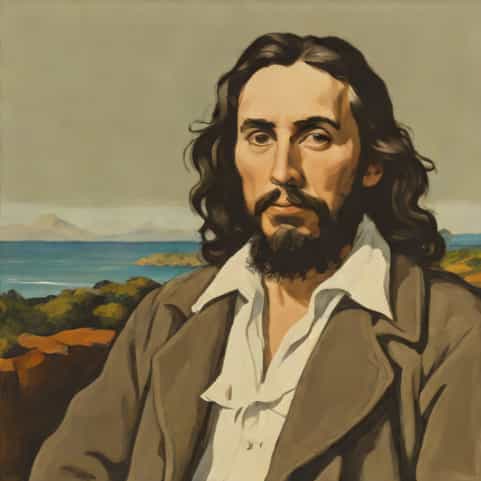
Gustave Courbet was a revolutionary French painter whose work challenged traditional artistic conventions and helped shape the Realist movement in the 19th century. Born on June 10, 1819, in Ornans, a small town in eastern France, Courbet grew up in a rural environment that would later influence much of his artistic vision. From a young age, he demonstrated a talent for drawing and a deep appreciation for nature and the lives of ordinary people. Courbet’s art was characterized by its commitment to depicting reality without idealization, portraying everyday scenes, landscapes, and human experiences with honesty and detail. His work not only transformed French painting but also sparked debates about the purpose and boundaries of art during a period of social and political change.
Early Life and Education
Gustave Courbet was born into a moderately prosperous farming family, which gave him firsthand exposure to rural life and the labor of ordinary people. His early education included drawing lessons, and he showed remarkable skill from a young age. Courbet moved to Paris to study law, but he soon abandoned legal studies to pursue a career in art. He attended art classes and studied the works of classical and contemporary painters, learning traditional techniques while also developing his own unique perspective on representation and composition.
Artistic Career and Development
Courbet began his artistic career in the 1840s, producing works that emphasized realism and social commentary. Unlike the Romantic and academic art of the time, which often depicted mythological or idealized subjects, Courbet focused on the everyday lives of ordinary people. His paintings featured peasants working in the fields, laborers, and landscapes that reflected the rugged beauty of rural France. This approach challenged the artistic establishment and laid the groundwork for the Realist movement.
Realism and Philosophy
Courbet was a key figure in the Realist movement, which rejected idealized depictions of history, mythology, or religious subjects in favor of portraying the world as it actually appeared. He believed that art should reflect life and social reality, capturing both beauty and hardship without romanticization. Courbet’s philosophy emphasized authenticity, often highlighting the dignity and struggles of ordinary people. This commitment to truth in representation became a defining characteristic of his work and influenced generations of artists.
Notable Works
Some of Courbet’s most famous works exemplify his Realist philosophy
- The Stone Breakers(1849) – Depicts two laborers breaking stones on a road, emphasizing the harsh realities of manual labor.
- A Burial at Ornans(1849-1850) – A large-scale painting portraying a funeral in his hometown, presenting common villagers in a grand, historical format traditionally reserved for nobility.
- The Origin of the World(1866) – A provocative work that challenges conventional depictions of the human body and emphasizes unidealized realism.
- Young Ladies of the Village(1852) – A scene highlighting social contrasts and interactions in a rural setting.
Each of these works demonstrates Courbet’s dedication to realism, social observation, and innovative composition.
Political Involvement and Controversy
Gustave Courbet was not only an artist but also politically active. He supported the Paris Commune of 1871, a radical socialist government that briefly controlled Paris. Courbet’s involvement included advocating for the creation of a museum dedicated to contemporary art and opposing government institutions that he viewed as oppressive. His political activities led to his imprisonment and financial penalties after the fall of the Commune, which significantly affected his later life and career.
Exile and Later Life
Following his release from prison, Courbet lived in exile in Switzerland, where he continued to paint but faced financial difficulties and declining health. Despite these challenges, he remained committed to his artistic principles, producing works that maintained his focus on realism and human experience. Courbet died on December 31, 1877, in La Tour-de-Peilz, Switzerland, leaving behind a legacy of innovation and defiance against artistic convention.
Impact on Art and Legacy
Gustave Courbet’s contributions to art extend far beyond his own paintings. By rejecting idealization and emphasizing realistic representation, he influenced later movements such as Impressionism and Modernism. Artists like Édouard Manet, Claude Monet, and Vincent van Gogh drew inspiration from Courbet’s commitment to portraying real life with honesty and emotional depth. His work also encouraged a broader conversation about the role of art in society, demonstrating that painting could serve as a vehicle for social commentary and political engagement.
Cultural Significance
Courbet’s work remains culturally significant because it represents a shift in how people understood art and its purpose. By elevating everyday subjects to the level of fine art, he challenged societal hierarchies and expanded the possibilities of artistic expression. Museums around the world continue to exhibit his works, and art historians regard him as a pioneer who bridged traditional techniques with modern perspectives on reality.
Techniques and Style
Courbet’s painting style is characterized by bold brushwork, attention to texture, and an emphasis on naturalistic detail. He often employed large canvases to give ordinary subjects a sense of grandeur and importance. Courbet’s approach combined rigorous observation with artistic intuition, capturing both the physical and emotional realities of his subjects. His use of light, composition, and perspective contributed to the immersive quality of his paintings.
Influence on Future Generations
The principles established by Courbet influenced numerous artistic movements, including Impressionism, Post-Impressionism, and 20th-century realism. Artists who sought to depict life authentically, rather than idealized versions, owe much to Courbet’s innovations. His insistence on depicting social realities also inspired political and socially conscious art in later generations.
Lessons From Gustave Courbet
- Commitment to authenticity and truth in one’s work.
- The value of challenging conventional norms and pushing artistic boundaries.
- Integrating social awareness and human experience into creative expression.
- The importance of perseverance despite political or societal obstacles.
- Innovation often arises from observation and engagement with the world as it is.
Why People Ask Quien Fue Gustave Courbet
People search for Gustave Courbet because he represents a turning point in art history, where realism, social commentary, and political engagement intersected with artistic innovation. Understanding who he was provides insight into the 19th-century art world, the rise of Realism, and the enduring question of how art can reflect society and human experience. Courbet’s legacy continues to inspire curiosity and admiration among art lovers, historians, and students worldwide.
Final Reflections on Gustave Courbet
Gustave Courbet was a revolutionary artist whose commitment to realism and social engagement reshaped the landscape of 19th-century painting. From his early experiences in rural France to his later political involvement and exile, his life reflects the challenges and possibilities of artistic and personal authenticity. By portraying ordinary life with dignity and honesty, Courbet established a legacy that continues to influence art, culture, and social consciousness. Understanding quien fue Gustave Courbet allows us to appreciate not only his technical skill and artistic vision but also his courage in challenging norms and advocating for the representation of real life in art.