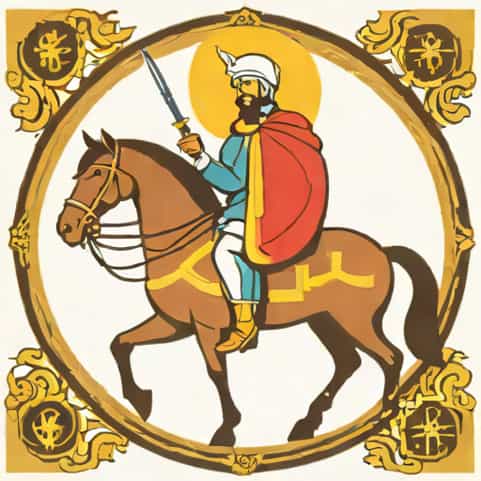
In the early 13th century, southern France became the stage of one of the most violent and complex religious wars in medieval Europe the Albigensian Crusade. At the center of this conflict was Simon de Montfort, a French nobleman who rose to prominence as one of the leading figures of the crusade. The campaign was launched against the Cathars, a Christian sect considered heretical by the Catholic Church. It combined religious zeal, political ambition, and territorial conquest, making Simon de Montfort a symbol of both faith and brutality. Understanding his role in the Albigensian Crusade reveals much about medieval power struggles, the nature of crusading in Europe, and the intersection of religion and politics during this turbulent era.
Background of the Albigensian Crusade
The Albigensian Crusade began in 1209, following a papal call by Pope Innocent III to eliminate the Cathar movement in the Languedoc region. The Cathars, sometimes known as Albigensians after the town of Albi, rejected many teachings of the Catholic Church. They believed in a dualistic universe where good and evil were in constant conflict, and they criticized the Church for its wealth and corruption. For the papacy, this represented a grave threat to religious authority, so a crusade was declared not in the Holy Land, but within Europe itself.
Conditions in Languedoc
The Languedoc region in southern France was culturally rich and politically fragmented. It was a land of castles, troubadours, and local lords who often resisted northern French influence. Many nobles tolerated or even supported the Cathars, creating an environment where heresy could flourish. The crusade was not only about eradicating heresy but also about extending northern control over this independent-minded region. Simon de Montfort became the man who embodied this mission.
Who Was Simon de Montfort?
Simon de Montfort, born around 1165, was a French nobleman with connections to both France and England. Before his role in the Albigensian Crusade, he had a reputation as a capable warrior and crusader, having participated in campaigns in the Holy Land. His strong Catholic faith and military skill made him a natural leader in the fight against the Cathars. When the crusade began, Simon emerged as one of its most determined commanders.
Rise to Leadership
After the crusade’s initial campaigns, many nobles who had joined returned home, leaving the task unfinished. Simon de Montfort accepted the role of leader in their absence. His decision marked the beginning of a personal crusade to not only defeat the Cathars but also to expand his own influence in southern France. This dual motivation-religious duty and personal ambition-shaped his actions throughout the conflict.
Major Campaigns Led by Simon de Montfort
Simon de Montfort’s leadership brought the crusaders both victories and infamy. His campaigns combined brutal military tactics with strong religious justification. He was relentless in his pursuit of the Cathars and their supporters, earning a reputation as both a devoted crusader and a ruthless conqueror.
- Siege of Béziers (1209)Although Simon was not yet the leader, the massacre at Béziers set the tone for the crusade. Thousands were killed, both Cathars and Catholics alike, under the principle that God would sort the faithful from the heretics.
- Siege of Carcassonne (1209)Simon played a role in capturing Carcassonne, one of the Cathar strongholds. After the city fell, its defenders were expelled, and Simon was granted the lands, marking the start of his territorial power in Languedoc.
- Battle of Muret (1213)One of Simon’s greatest victories, where he defeated the forces of Peter II of Aragon, who had come to support the Cathars. This victory strengthened Simon’s control over the region and solidified his reputation as a formidable commander.
Tactics and Brutality
Simon de Montfort’s campaigns were marked by a combination of military innovation and extreme violence. He relied on sieges, fortified castles, and strategic alliances. However, he also used terror as a weapon, often destroying entire towns and punishing populations that resisted. This approach spread fear and forced many lords to submit to his authority, but it also earned him lasting infamy in the region.
Conflict with Local Lords
While Simon de Montfort gained land and power, his rule was not welcomed by many in Languedoc. Local nobles resented the intrusion of northern French crusaders. Families such as the Trencavels lost their ancestral lands, and resistance movements began to form. Simon’s efforts to impose northern feudal customs clashed with the local traditions of relative independence and tolerance. As a result, his leadership was constantly challenged, both militarily and politically.
The Role of the Catholic Church
The Catholic Church supported Simon de Montfort, granting him legitimacy and authority. Papal legates praised his efforts, and he was often presented as a model crusader. Yet, the brutality of the campaigns also raised concerns, as even church officials questioned the morality of indiscriminate slaughter. Still, the papacy saw Simon as essential in achieving its goal of eradicating heresy in Languedoc.
Death of Simon de Montfort
Simon’s dominance in the Albigensian Crusade ended abruptly in 1218. During the siege of Toulouse, one of the last major strongholds resisting his authority, he was killed by a stone hurled from a catapult operated by the city’s defenders. His death marked a turning point in the crusade, as his charisma and leadership had been central to its progress. Without him, the crusaders struggled to maintain the same level of momentum.
Legacy of His Leadership
Simon de Montfort’s legacy is deeply controversial. To the Catholic Church, he was a defender of the faith who fought tirelessly against heresy. To the people of Languedoc, he was often remembered as a foreign oppressor who brought destruction to their lands. His actions left a lasting scar on the region, reshaping its politics, culture, and religious identity for centuries to come.
The Impact of the Albigensian Crusade
Even after Simon’s death, the Albigensian Crusade continued under his successors, eventually leading to the decline of Catharism and the integration of Languedoc into the French crown’s domain. The crusade had profound effects
- It weakened the power of local nobles in southern France.
- It expanded the influence of the French monarchy into previously independent regions.
- It demonstrated how crusading ideals could be applied within Europe, not just in the Holy Land.
- It created lasting resentment and cultural divides between northern and southern France.
Simon de Montfort and the Albigensian Crusade
Simon de Montfort’s role in the Albigensian Crusade illustrates the complex nature of medieval religious wars. His life and campaigns show how faith, ambition, and politics intertwined in a struggle that reshaped southern France. While his military successes brought temporary dominance, his brutal methods also fueled resistance and left a dark legacy. The Albigensian Crusade ultimately achieved its goal of suppressing the Cathar heresy, but it came at a tremendous human cost. Simon de Montfort remains one of the most memorable, if controversial, figures of this chapter in history-admired by some as a devoted crusader and condemned by others as a ruthless conqueror.
By examining Simon de Montfort and the Albigensian Crusade, one gains a deeper understanding of how religious fervor could both unite and divide medieval society, and how individuals could shape the course of history through their ambition, faith, and determination.