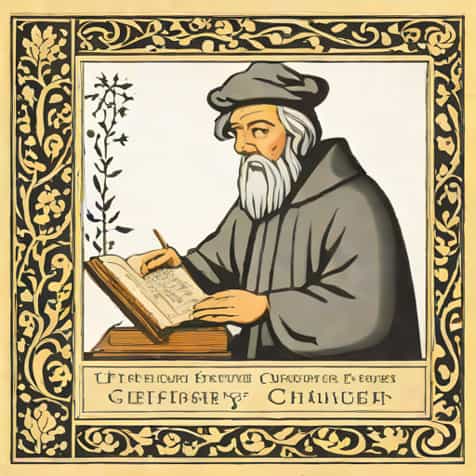
Among the many treasures of English literature, The Poetical Works of Geoffrey Chaucer stands as one of the most influential collections in history. Chaucer, often referred to as the Father of English Poetry, wrote during the 14th century a time when English was still shaping into the literary language we know today. His writings not only reflect the culture, humor, and morality of medieval England but also laid the foundation for modern English storytelling. Through rhythm, vivid imagery, and deep insight into human nature, Chaucer created works that remain relevant even centuries later.
The Life and Times of Geoffrey Chaucer
Geoffrey Chaucer was born around 1343 in London, England. Coming from a middle-class family, he was fortunate to receive an education that exposed him to languages like Latin, French, and Italian, which later influenced his writing. Chaucer served as a court official, diplomat, and civil servant, positions that allowed him to observe people from all social backgrounds royalty, clergy, and commoners alike. These experiences gave him a unique understanding of society, which he vividly captured in his poetry.
Living during the Middle Ages, Chaucer witnessed a world of political tension, religious authority, and social transformation. His poems often reveal his observations of the corruption, hypocrisy, and complexity of human behavior. His blend of satire, realism, and humor made his poetry appealing to readers from all walks of life.
Major Works in The Poetical Collection
The poetical works of Geoffrey Chaucer include several notable pieces that have shaped English literature. Each poem offers something different romance, moral lessons, social commentary, and even comedy. Below are some of the most significant works within his collection.
The Canterbury Tales
The Canterbury Tales is perhaps Chaucer’s most famous and enduring work. It is a collection of stories told by a group of pilgrims traveling to the shrine of Saint Thomas Becket in Canterbury. Each pilgrim tells a tale to entertain the group, resulting in a colorful mosaic of medieval life. Through these stories, Chaucer explores themes of love, greed, power, and faith, while also offering sharp social criticism.
- The Knight’s TaleA story of chivalry, love, and destiny that reflects noble ideals and moral conflict.
- The Miller’s TaleA humorous, bawdy story that mocks romantic traditions and social pretensions.
- The Wife of Bath’s TaleA feminist narrative that discusses marriage, power, and gender roles.
- The Pardoner’s TaleA moral story exposing greed and hypocrisy within the church.
Each tale is distinct in tone and message, but together they form a rich portrait of 14th-century England its people, values, and contradictions.
Troilus and Criseyde
This long narrative poem is a tragic love story set during the Trojan War. It tells the tale of Troilus, a Trojan prince, and Criseyde, a widow who eventually betrays his love. Chaucer’s handling of emotion, fate, and moral struggle in this poem reveals his deep understanding of human psychology. The work also influenced later writers, including Shakespeare, who drew inspiration for Troilus and Cressida.
The Book of the Duchess
One of Chaucer’s earliest known works, The Book of the Duchess is an elegy written in honor of Blanche, Duchess of Lancaster. The poem uses dream vision to express grief and loss. In it, the narrator meets a sorrowful knight who laments the death of his beloved. The work displays Chaucer’s growing mastery of symbolism, allegory, and poetic rhythm.
The House of Fame
This allegorical poem explores the nature of fame and reputation. In a dream-like sequence, the poet is guided by an eagle to the House of Fame, where he witnesses how human deeds are remembered or forgotten over time. The poem humorously questions what makes someone truly famous, revealing Chaucer’s insight into vanity and social ambition.
Parliament of Fowls
In this charming poem, Chaucer describes a dream vision where birds gather to choose their mates on Valentine’s Day. It is one of the earliest known references to this holiday as a celebration of romantic love. The Parliament of Fowls blends humor, philosophy, and political allegory, making it both entertaining and thought-provoking.
Language and Style in Chaucer’s Poetry
One of the most remarkable aspects of Chaucer’s poetry is his use of Middle English the form of the English language spoken between 1150 and 1500. Before Chaucer, most serious literature in England was written in Latin or French. By choosing English, he elevated the language’s status and demonstrated its expressive potential.
Chaucer’s writing features a rhythmic quality, often using iambic pentameter, which later became a standard in English poetry. His vocabulary is rich with vivid imagery and humor, and his characters speak in realistic voices. He skillfully balances moral lessons with wit, allowing readers to learn and laugh at the same time.
Influence of Other Literary Traditions
Chaucer’s works show influences from classical, French, and Italian writers. He admired Dante, Petrarch, and Boccaccio, and their styles helped shape his poetic approach. However, Chaucer adapted these influences into something uniquely English combining European sophistication with the everyday speech and humor of his homeland.
Themes Explored in Chaucer’s Poetry
The poetical works of Geoffrey Chaucer touch upon universal themes that remain relevant today. His ability to mix morality, comedy, and social realism makes his writing timeless.
- Human NatureChaucer portrays both virtues and flaws love, greed, jealousy, faith, and pride.
- Social ClassHis characters come from every level of society, revealing both the divisions and commonalities among people.
- ReligionChaucer often critiques corruption within the church while maintaining respect for true spirituality.
- Love and DesireFrom romantic idealism to betrayal, his works examine the complexities of human relationships.
- Justice and MoralityMany of his tales explore what it means to live a good and virtuous life.
These recurring ideas help readers reflect on their own moral values and the society they live in just as they did for Chaucer’s audience in medieval England.
The Legacy of Geoffrey Chaucer
Geoffrey Chaucer’s contribution to English literature cannot be overstated. His use of English helped standardize the language, and his poetic innovations influenced countless writers after him. Authors like William Shakespeare, John Dryden, and Alexander Pope all drew inspiration from his works.
The Poetical Works of Geoffrey Chaucer have been studied and reprinted for centuries. They not only entertain but also preserve a vivid record of medieval thought, humor, and social life. Modern scholars continue to explore his writings for their linguistic richness and psychological depth.
Chaucer’s Lasting Impact on English Culture
Even today, Chaucer’s influence can be found in modern storytelling. His ability to weave together diverse voices and perspectives set a precedent for narrative complexity. In many ways, he was the first true English novelist, even before novels existed as a form. His understanding of humanity both noble and flawed still resonates with readers of all ages.
The Poetical Works of Geoffrey Chaucer represent more than just a collection of medieval poems they are the birth of English literature as we know it. Through his mastery of language, humor, and social insight, Chaucer bridged the gap between the ancient and modern worlds. His works invite readers to laugh, question, and reflect on the human experience. Whether exploring the lively tales of pilgrims or the tragic fate of lovers, Chaucer captures the full range of emotion and complexity that defines humanity. His poetry endures because it speaks not only to his time but to all times a testament to the timeless power of art and language.