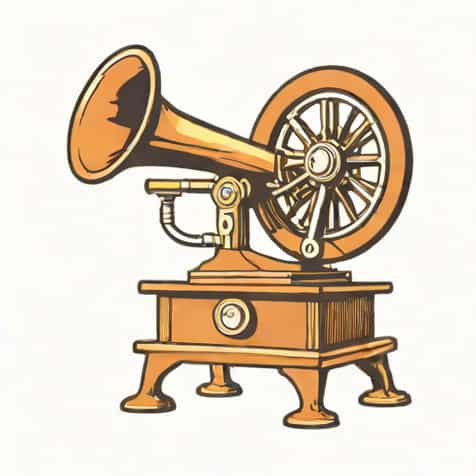
Thomas Edison’s invention of the phonograph marked a groundbreaking moment in history, changing the way people experienced sound and communication forever. Before the phonograph, the idea of recording and replaying sound seemed like science fiction, but Edison’s ingenuity turned this concept into reality. His invention not only revolutionized music and entertainment but also laid the foundation for modern audio technology. The phonograph became a symbol of human innovation, demonstrating how creativity, persistence, and technical knowledge could transform the impossible into something tangible and impactful.
The Early Life of Thomas Edison
Thomas Alva Edison, born in 1847 in Milan, Ohio, showed remarkable curiosity and inventiveness from a young age. Despite limited formal schooling, Edison’s interest in science and mechanics drove him to experiment and explore new ideas. His early exposure to telegraphy and electrical devices provided the foundation for his later inventions. Edison’s perseverance, resourcefulness, and ability to learn from failures allowed him to become one of history’s most prolific inventors, holding over a thousand patents by the end of his lifetime.
Inspiration Behind the Phonograph
The invention of the phonograph was inspired by Edison’s fascination with telegraph and telephone technology. He envisioned a device that could capture and reproduce sound mechanically, extending communication beyond live interactions. Edison’s goal was to create a machine capable of recording any sound, preserving it for playback at a later time. This ambitious idea required innovative thinking and the ability to combine existing technologies in unprecedented ways.
The Invention of the Phonograph
In 1877, Thomas Edison successfully invented the phonograph, a machine that could record and play back sound. The device used a cylinder wrapped in tin foil and a stylus that etched grooves corresponding to sound vibrations. When the cylinder was rotated, the stylus retraced the grooves, reproducing the original sound. This simple yet revolutionary mechanism demonstrated for the first time that sound could be captured and replayed mechanically, opening up countless possibilities for entertainment, communication, and education.
Technical Details
Edison’s phonograph operated using a combination of mechanical parts that worked in harmony. A hand-crank or motor rotated the cylinder while a diaphragm vibrated in response to sound waves. These vibrations were transferred to a stylus, which etched the sound onto the cylinder’s surface. During playback, the stylus retraced the grooves, causing the diaphragm to vibrate and reproduce the recorded sound. This ingenious system represented a leap forward in audio technology and paved the way for future developments in sound recording and reproduction.
Impact on Music and Entertainment
The phonograph had a profound impact on the music industry and entertainment. For the first time, people could listen to recorded music at home, transforming the way music was consumed and appreciated. Musicians gained a new platform to share their work, and audiences could enjoy performances without being physically present. The phonograph also facilitated the preservation of cultural heritage, as songs, speeches, and performances could now be documented and passed down through generations.
Home Listening Experience
The phonograph brought music into households, creating a more personal and immersive listening experience. Families could enjoy songs, stories, and educational recordings in the comfort of their own homes. This accessibility democratized music and sound, making it available to a wider audience than ever before. The ability to replay recordings also changed the way people engaged with music, allowing them to appreciate nuances and develop a deeper connection with sound.
Recording Industry Beginnings
Edison’s invention laid the foundation for the modern recording industry. The phonograph enabled commercial recordings, leading to the creation of record labels, distribution networks, and a thriving music market. Artists could reach listeners far beyond live performances, and audiences could access a growing catalog of recordings. This innovation reshaped the entertainment landscape and set the stage for technological advancements such as vinyl records, magnetic tape, and digital audio.
Broader Applications of the Phonograph
Beyond music, Edison recognized the phonograph’s potential for communication, education, and business. The device was used to record dictations, correspondence, and lectures, making information storage and sharing more efficient. Educators could record lessons for students, businesses could document meetings and messages, and inventors could preserve ideas for later development. The phonograph’s versatility demonstrated that its impact extended far beyond entertainment, influencing many aspects of society.
Education and Learning
Teachers and scholars began using the phonograph as an educational tool, recording lessons, language lessons, and scientific demonstrations. Students could listen repeatedly to recordings, enhancing their understanding and retention. This innovation contributed to the development of audio-based learning and laid the groundwork for modern educational technologies such as audiobooks, podcasts, and online courses.
Business and Communication
In business, the phonograph facilitated communication by allowing messages to be recorded and replayed. Entrepreneurs, inventors, and managers could document instructions, announcements, and plans more efficiently than writing or telegraphing alone. The device also helped standardize communication across organizations, reducing errors and improving productivity. Edison’s invention thus influenced both the cultural and practical aspects of modern life.
Legacy of Thomas Edison’s Phonograph
Thomas Edison’s invention of the phonograph remains one of the most significant technological achievements in history. It revolutionized the way people experience sound, laying the groundwork for modern audio technology, recording industries, and communication methods. Edison’s pioneering work inspired countless inventors and engineers to improve upon his designs, leading to innovations such as gramophones, vinyl records, magnetic tape, and digital audio formats.
Recognition and Influence
Edison received widespread recognition for the phonograph, solidifying his reputation as a leading inventor of his time. The phonograph exemplifies his approach to problem-solving combining creativity, persistence, and practical engineering. Its influence continues today, as modern sound recording and playback technologies still rely on the principles Edison introduced. From smartphones to streaming services, the phonograph’s legacy is evident in every corner of contemporary audio consumption.
Inspiration for Future Inventors
The phonograph serves as a source of inspiration for future generations of inventors and innovators. Edison’s dedication to experimentation, willingness to embrace failure, and relentless pursuit of solutions highlight the importance of perseverance and ingenuity. The phonograph reminds us that transformative ideas often begin as simple concepts, which, through creativity and determination, can change the world.
Thomas Edison’s invention of the phonograph represents a pivotal moment in human history. By transforming sound into a recordable and replayable medium, Edison opened the doors to modern music, communication, and audio technology. The phonograph enriched cultural experiences, enhanced education, and revolutionized entertainment, leaving an indelible mark on society. Its legacy continues to influence our daily lives, reminding us of the power of innovation and the lasting impact of human creativity.
Understanding Edison’s contribution to sound recording not only honors his ingenuity but also highlights the ongoing significance of his work in today’s technologically advanced world. The phonograph exemplifies how a single invention can transform multiple aspects of life, inspiring generations to explore, innovate, and reshape the way we experience the world. Thomas Edison’s phonograph remains a testament to human potential, perseverance, and the enduring quest to turn visionary ideas into reality.