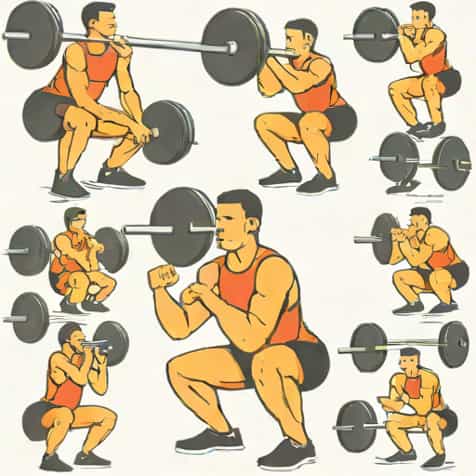
The front squat is a fundamental strength training exercise that targets the quadriceps, glutes, and core muscles while also engaging the upper back and shoulders for stability. Unlike the back squat, the barbell is positioned on the front of the shoulders, requiring a more upright torso and increased mobility in the wrists, elbows, and thoracic spine. Over the years, fitness enthusiasts and athletes have developed various front squat variations to address different training goals, improve performance, and target muscles more effectively. Exploring these variations helps in building balanced strength, enhancing athletic performance, and preventing injury.
Standard Front Squat
The standard front squat serves as the foundation for all other variations. In this exercise, the barbell rests on the front deltoids, held in place by crossing the arms or using the clean grip. Feet are placed shoulder-width apart, and the movement involves lowering the hips down while keeping the torso upright, then pushing back up to the starting position. This version emphasizes quadriceps activation more than traditional back squats and encourages proper posture and core stability.
Key Benefits of the Standard Front Squat
- Strengthens the quadriceps, glutes, and core muscles.
- Improves posture and spinal alignment due to upright torso requirement.
- Enhances mobility in the wrists, shoulders, and thoracic spine.
- Reduces stress on the lower back compared to back squats.
Clean Grip Front Squat
The clean grip front squat involves holding the barbell on the front deltoids with a grip similar to the clean portion of a clean and jerk. This variation requires flexibility in the wrists and shoulders to maintain proper form. The clean grip allows for heavier loading while still keeping the torso upright, making it a favorite among Olympic weightlifters. It also improves the athlete’s ability to receive and stabilize the barbell during the clean portion of lifts.
Technique Tips
- Keep elbows high and pointed forward throughout the movement.
- Maintain a tight core to prevent the torso from leaning forward.
- Ensure feet are flat on the ground and knees track over toes.
Cross-Arm Front Squat
The cross-arm front squat is an alternative for those with limited wrist or shoulder mobility. Instead of gripping the barbell with the hands, the bar rests across the front deltoids while the arms are crossed over the bar, pressing it against the shoulders. This variation reduces strain on the wrists and allows individuals to focus on leg and core strength without compromising form. It is ideal for beginners or anyone struggling to maintain the clean grip position.
Advantages
- Reduces stress on wrists and forearms.
- Allows more individuals to safely perform front squats.
- Maintains emphasis on quadriceps and core stability.
Goblet Front Squat
The goblet squat is a front squat variation performed using a dumbbell or kettlebell held close to the chest. This variation is excellent for beginners, as it teaches proper squat mechanics and upright torso positioning. The goblet front squat also improves grip strength and core engagement while providing a safer way to practice front squats without a barbell. It can be used as a warm-up or accessory exercise for strength and conditioning programs.
How to Perform Goblet Front Squat
- Hold a dumbbell or kettlebell at chest height with both hands.
- Keep elbows pointing down or slightly forward.
- Lower hips down while keeping the torso upright and chest lifted.
- Push through heels to return to the starting position.
Front Squat with Chains or Bands
Adding resistance bands or chains to front squats is a popular variation among advanced lifters seeking to improve explosive strength and stability. Chains and bands create variable resistance, making the lift more challenging at the top range of motion while reducing load at the bottom. This method promotes acceleration through the lift and improves overall power output, which is particularly useful for athletes involved in sprinting, jumping, or Olympic weightlifting.
Benefits of Variable Resistance
- Enhances strength throughout the entire range of motion.
- Improves power and explosiveness.
- Encourages stability and balance under changing load conditions.
Front Squat with Pause
The pause front squat requires pausing at the bottom of the squat before returning to the starting position. This variation eliminates momentum and forces the lifter to maintain tension in the core and legs, promoting strength in the sticking point of the squat. Pause front squats are particularly effective for building stability, control, and muscle endurance, making them a valuable tool in strength training programs.
Key Tips for Pause Squats
- Pause for 1-3 seconds at the bottom of the squat.
- Keep the torso upright and chest lifted during the pause.
- Engage the core to maintain balance and prevent forward lean.
Front Squat with Narrow or Wide Stance
Adjusting the stance width during front squats changes muscle recruitment and challenges balance differently. A narrow stance emphasizes quadriceps engagement, while a wider stance recruits more glutes and inner thigh muscles. These variations allow lifters to target specific muscle groups, improve hip mobility, and accommodate individual biomechanics for safer lifting.
Stance Variation Considerations
- Narrow stance feet close together, more quadriceps-focused.
- Wide stance feet wider than shoulder-width, increased glute and adductor activation.
- Always maintain proper knee alignment to prevent strain.
Single-Leg Front Squat
The single-leg front squat, also known as a pistol squat, is an advanced variation that places the load on one leg at a time. This exercise improves unilateral strength, balance, and coordination while targeting the quads, glutes, and stabilizing muscles. It also corrects muscle imbalances and increases ankle and hip mobility. Adding a dumbbell or kettlebell for resistance can increase the challenge and further enhance strength development.
Key Points for Single-Leg Front Squats
- Focus on controlled descent and ascent.
- Keep the non-working leg extended in front of the body.
- Use a support or counterbalance if necessary for stability during the movement.
The front squat is a versatile exercise with many variations to suit different skill levels, goals, and anatomical needs. Standard front squats, clean grip, cross-arm, goblet, paused, variable resistance, stance variations, and single-leg front squats all offer unique benefits. Incorporating these variations into a strength training program can improve quadriceps and glute strength, enhance core stability, increase mobility, and prevent injury. By exploring these different front squat variations, lifters can develop a balanced and powerful lower body while maintaining proper form and reducing the risk of strain or injury.