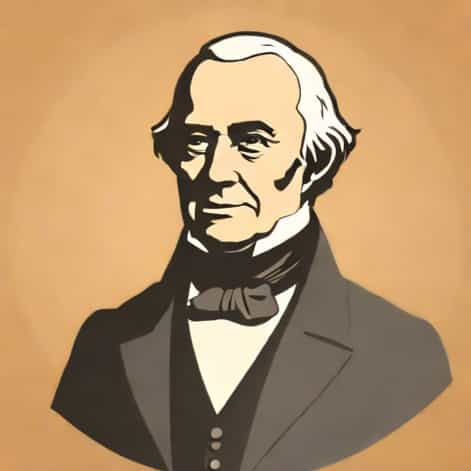
John Quincy Adams was an influential figure in American history, serving as the sixth President of the United States and leaving a lasting impact on both domestic and foreign policy. Born on July 11, 1767, in Braintree, Massachusetts, Adams was the son of John Adams, the second President of the United States, and Abigail Adams, a respected intellectual and political advisor. From an early age, he was immersed in the ideals of the American Revolution and public service, shaping his worldview and preparing him for a life devoted to diplomacy, governance, and the pursuit of justice.
Early Life and Education
John Quincy Adams grew up during a period of significant political change and upheaval. His parents instilled in him a sense of duty, patriotism, and the importance of education. He attended Harvard College, where he excelled academically and developed a deep interest in law, politics, and languages. Adams’ upbringing exposed him to international affairs early on, as his father’s political career involved diplomatic service abroad. This exposure influenced his future role as a skilled diplomat and statesman who navigated complex international relations.
Diplomatic Career
Adams’ diplomatic career began in his youth, serving in various capacities in Europe. He was a secretary to the U.S. delegation in the Netherlands and later served in Prussia and Russia. His extensive knowledge of European politics, languages, and culture allowed him to represent American interests effectively abroad. One of his most significant accomplishments as a diplomat was his role in negotiating the Treaty of Ghent in 1814, which ended the War of 1812 between the United States and Britain. Adams’ diplomatic skill earned him recognition as one of the most capable American foreign ministers of his time.
Secretary of State
Before becoming president, John Quincy Adams served as Secretary of State under President James Monroe from 1817 to 1825. In this role, he played a key part in shaping American foreign policy, including the formulation of the Monroe Doctrine, which asserted opposition to European colonization in the Americas. Adams was instrumental in negotiating treaties with foreign nations, settling boundary disputes, and promoting trade relations. His tenure as Secretary of State established him as a formidable statesman with a vision for the United States as a respected and independent nation on the global stage.
Presidency
John Quincy Adams was elected as the sixth President of the United States in 1824. His presidency, which lasted from 1825 to 1829, was marked by ambitious domestic initiatives, including support for internal improvements such as roads, canals, and educational institutions. However, his presidency faced significant challenges, including opposition from political rivals and the rise of Andrew Jackson, who appealed to a broader popular base. Despite his vision for national development, Adams struggled to achieve legislative success due to political opposition and the evolving nature of American democracy.
Post-Presidency and Congressional Career
After losing the 1828 election to Andrew Jackson, John Quincy Adams embarked on a second phase of public service in the U.S. House of Representatives, where he served from 1831 until his death in 1848. During this period, he became a leading advocate against slavery, arguing passionately for abolition and the rights of African Americans. Adams earned the nickname Old Man Eloquent for his skillful oratory and principled stand on moral and constitutional issues. His post-presidential career demonstrated his enduring commitment to justice, human rights, and the rule of law, leaving a legacy that extended far beyond his time in the White House.
Legacy and Influence
John Quincy Adams is remembered as one of the most dedicated and intellectually rigorous figures in American history. His contributions to diplomacy, law, and moral leadership set a standard for public service. He played a critical role in establishing the United States’ position in the international community, advocating for ethical governance, and promoting education and infrastructure development. His principled stance against slavery and commitment to human rights highlight his enduring moral vision, influencing future generations of leaders and reformers. Adams’ life exemplifies the challenges and responsibilities of public service, demonstrating how intellect, dedication, and integrity can shape a nation’s path.
Personal Life
John Quincy Adams married Louisa Catherine Johnson in 1797, and their partnership was marked by mutual support and shared dedication to public service. They had four children, and Adams’ personal letters reveal his deep concern for family, education, and civic responsibility. His upbringing and family life grounded him in values that informed his public actions, balancing personal commitment with professional duty. Adams’ life as a family man, diplomat, president, and congressman reflects a multi-faceted career shaped by principle and perseverance.
John Quincy Adams remains a significant figure in American history, known for his intelligence, diplomatic skill, and unwavering commitment to justice. From his early exposure to international politics to his service as Secretary of State, President, and Congressman, Adams shaped the course of American governance and foreign policy. His advocacy for human rights, particularly his opposition to slavery, underscores the enduring relevance of his moral vision. Remembered as both a statesman and a principled public servant, John Quincy Adams’ legacy continues to inspire those who seek to balance intellect, ethics, and leadership in the service of their nation.