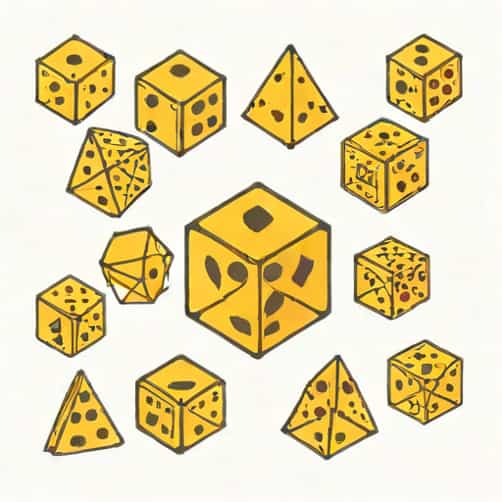
Yahtzee is a classic dice game that has entertained families and friends for generations. Traditionally played with five six-sided dice, the game challenges players to roll specific combinations to score points across different categories. However, enthusiasts and tabletop gamers have introduced exciting variations by incorporating polyhedral dice, which include four-sided, eight-sided, ten-sided, twelve-sided, and twenty-sided dice. Using polyhedral dice transforms the familiar Yahtzee experience, adding new levels of strategy, probability considerations, and unpredictability. This adaptation is especially popular among role-playing game fans who are accustomed to rolling various dice in games like Dungeons & Dragons. By exploring Yahtzee with polyhedral dice, players can discover fresh ways to enjoy the classic game while engaging with the unique mechanics and challenges that non-standard dice provide.
Understanding Polyhedral Dice
Polyhedral dice are dice with different numbers of sides beyond the traditional six. Each die type is labeled according to its number of faces d4 (four-sided), d6 (six-sided), d8 (eight-sided), d10 (ten-sided), d12 (twelve-sided), and d20 (twenty-sided). Polyhedral dice are commonly used in tabletop role-playing games to determine outcomes, resolve combat, or calculate random events. Integrating these dice into Yahtzee introduces a broader range of possible rolls and increases the complexity of scoring combinations. Players need to adapt their strategies to account for dice with higher or lower probabilities of rolling specific numbers, which adds a new layer of challenge and excitement to the traditional game.
Types of Polyhedral Dice for Yahtzee
- d4 A four-sided die shaped like a tetrahedron, with numbers ranging from 1 to 4.
- d6 The standard six-sided die traditionally used in Yahtzee, included for hybrid versions.
- d8 An eight-sided die shaped like an octahedron, with numbers 1 through 8.
- d10 A ten-sided die commonly used for percentile rolls, with numbers 0-9 or 1-10.
- d12 A twelve-sided die shaped like a dodecahedron, ranging from 1 to 12.
- d20 A twenty-sided die shaped like an icosahedron, with numbers 1 through 20.
How Yahtzee Changes with Polyhedral Dice
When playing Yahtzee with polyhedral dice, the game’s core objective-achieving specific combinations-remains the same, but the methods and probabilities shift. Players must roll combinations such as full houses, straights, and five-of-a-kind, now taking into account the extended or reduced number range of their dice. For example, rolling a Yahtzee with five d12 dice is statistically less likely than rolling five d6 dice, making high-score strategies riskier and more rewarding. Similarly, a small straight with d8 dice may require more flexible thinking, as the numeric sequence differs from the classic 1-2-3-4-5-6 sequence. The use of polyhedral dice also encourages creativity in scoring rules, with some players introducing new categories tailored to the dice type.
Advantages of Using Polyhedral Dice
- Increased variety and unpredictability, keeping the game fresh.
- Enhanced strategic depth due to varied probability distributions.
- Appeal to tabletop role-playing game enthusiasts familiar with polyhedral dice.
- Opportunities for creating customized scoring rules based on dice type.
- Encourages players to think creatively and adapt strategies for different dice outcomes.
Scoring Adaptations for Polyhedral Yahtzee
Traditional Yahtzee scoring includes categories such as ones through sixes, three-of-a-kind, four-of-a-kind, full house, small straight, large straight, Yahtzee, and chance. When using polyhedral dice, players may need to adapt these categories to account for higher or lower numbers. For example, a d10 Yahtzee could have scoring categories ranging from ones to tens, while a d12 version might use ones to twelves. Similarly, straight sequences can be modified to match the dice type. Some players even introduce super Yahtzee bonuses for rolling five-of-a-kind on dice with more than six sides, rewarding players for achieving difficult combinations. This flexibility allows polyhedral Yahtzee to remain both challenging and fun for players of all skill levels.
Example Scoring Adjustments
- d8 Yahtzee Scoring categories 1-8 for singles, modified straights from 1-5, 2-6, or 4-8.
- d10 Yahtzee Categories 1-10, with super Yahtzee bonus for rolling five identical dice.
- d12 Yahtzee Categories 1-12, modified small and large straights, optional high-value bonus categories.
- d20 Yahtzee Scoring could include 1-20 categories, with special bonus points for extreme rolls.
Strategies for Playing Yahtzee with Polyhedral Dice
Adapting strategies to polyhedral Yahtzee requires understanding the probability differences between dice types. For instance, the likelihood of rolling five identical numbers decreases as the number of sides increases, making riskier moves less frequent but more rewarding. Similarly, creating straights becomes more challenging with dice that have a wider numeric range. Players need to decide whether to aim for conservative scoring with achievable combinations or take calculated risks for high-reward outcomes. Balancing chance and strategy is key to succeeding in this variation of Yahtzee. Additionally, keeping track of which dice to re-roll and when becomes more complex and engaging, giving experienced players a deeper tactical experience.
Effective Strategies
- Prioritize achievable combinations early, especially when using high-sided dice.
- Use re-rolls wisely to maximize potential high-scoring outcomes.
- Consider probability distributions of each die type when choosing scoring categories.
- Adapt straight and full house strategies based on the numeric range of the dice.
- Take calculated risks for high-value Yahtzees or super Yahtzees on higher-sided dice.
Polyhedral Yahtzee as a Social Game
Beyond strategy and probability, Yahtzee with polyhedral dice remains a social and interactive game. It encourages friendly competition, conversation, and laughter, making it ideal for game nights or gatherings. Polyhedral dice add visual appeal, variety, and excitement as players roll unfamiliar dice shapes. The novelty of using different dice often sparks creativity in house rules and scoring adaptations, making each session unique. Additionally, polyhedral Yahtzee can serve as an educational tool for teaching probability, statistics, and critical thinking in a fun and engaging manner.
Social and Educational Benefits
- Encourages teamwork, friendly competition, and social interaction.
- Introduces probability concepts in an interactive way.
- Stimulates creativity in scoring rules and house variations.
- Offers visual and tactile engagement with unique polyhedral dice.
- Promotes problem-solving and strategic thinking in players of all ages.
Yahtzee with polyhedral dice offers a fresh take on a classic game, blending familiarity with the excitement of varied dice types. By incorporating d4, d8, d10, d12, or d20 dice, players face new challenges in scoring, probability, and strategy. This variation not only appeals to traditional Yahtzee fans but also attracts tabletop role-playing enthusiasts and those seeking a more dynamic gaming experience. Whether for casual play, competitive scoring, or educational purposes, polyhedral Yahtzee provides endless opportunities for fun, creativity, and engagement. Adapting strategies, customizing scoring, and embracing the unpredictable nature of polyhedral dice ensures that every game session is both exciting and rewarding for players of all ages and experience levels.