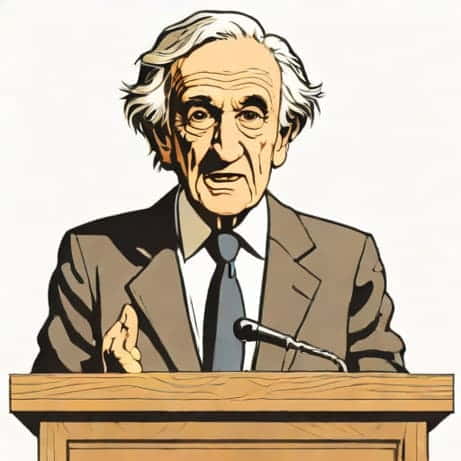
Elie Wiesel’s acceptance speech, delivered upon receiving the Nobel Peace Prize in 1986, stands as one of the most powerful and enduring testimonies of human resilience, moral responsibility, and the pursuit of justice. Wiesel, a Holocaust survivor, author, and advocate for human rights, used this platform not merely to acknowledge his own achievements but to draw attention to the suffering of millions and to remind the world of the dangers of indifference. His words resonated far beyond the walls of the Oslo City Hall, inspiring generations to confront injustice and remember the lessons of history. The speech reflects both his personal journey and his lifelong dedication to bearing witness, ensuring that memory, conscience, and action are intertwined in the fight against oppression and violence.
Historical Context of the Speech
Elie Wiesel’s acceptance speech must be understood within the broader historical context of his life and the state of the world in 1986. Having survived Auschwitz and Buchenwald concentration camps, Wiesel dedicated his life to Holocaust remembrance and advocacy for oppressed populations. By the mid-1980s, he had become a leading voice on issues of human rights, speaking out against genocide, anti-Semitism, and political oppression. The Nobel Committee recognized his tireless work in promoting peace, understanding, and moral responsibility, making the acceptance speech both a personal acknowledgment and a call to global conscience. The speech was delivered in Oslo, Norway, amid international attention, emphasizing the urgency of his message in a world still grappling with conflicts and human rights violations.
Key Themes of Wiesel’s Speech
Several recurring themes define Elie Wiesel’s Nobel Peace Prize acceptance speech
- Memory and WitnessWiesel emphasizes the importance of remembering past atrocities, particularly the Holocaust, to prevent future atrocities.
- Indifference and ResponsibilityHe warns against societal indifference, arguing that inaction in the face of injustice contributes to the perpetuation of suffering.
- Human Rights and Moral CourageWiesel advocates for active engagement in promoting human rights and standing against oppression.
- Hope and ResilienceDespite recounting horrific experiences, Wiesel’s speech conveys a sense of hope, urging humanity to rise above cruelty.
Memory as a Moral Imperative
In his acceptance speech, Wiesel repeatedly emphasizes that memory is not merely a personal act but a moral obligation. He frames remembrance as a duty to the victims who can no longer speak for themselves. By keeping their stories alive, he asserts, society upholds justice and cultivates empathy. Wiesel’s insistence on the power of memory resonates with educators, historians, and activists, highlighting the role of historical consciousness in shaping ethical decision-making. The speech underscores that memory is the foundation of moral accountability, reminding the world that forgetting history is a path to repeating it.
Condemnation of Indifference
A central pillar of Wiesel’s speech is his condemnation of indifference. He argues that apathy in the face of suffering is more dangerous than hatred because it allows injustice to persist unchallenged. Wiesel illustrates this theme through poignant examples from history, including the Holocaust, and applies it to contemporary events of his time. He calls on individuals, governments, and international organizations to recognize that ignoring oppression is complicity. This message extends beyond his specific context, offering timeless guidance for addressing modern human rights crises. By highlighting indifference as a moral failure, Wiesel’s speech urges active engagement and moral responsibility in daily life.
Advocacy for Human Rights
Wiesel’s acceptance speech is not only a reflection on past atrocities but also a call to action in the present. He draws attention to ongoing injustices around the world, urging listeners to confront oppression wherever it exists. Human rights, Wiesel asserts, are universal and indivisible; protecting them requires courage, vigilance, and collective action. His advocacy emphasizes that peace is more than the absence of war it is the presence of justice and the protection of human dignity. Through his words, Wiesel challenges global leaders and citizens alike to act decisively in the service of humanity, reinforcing the central mission of the Nobel Peace Prize.
Language and Rhetorical Style
Wiesel’s rhetorical style in the acceptance speech is characterized by clarity, emotional resonance, and moral authority. He balances personal testimony with universal appeal, combining vivid recollections of the Holocaust with ethical reflections relevant to all of humanity. His use of repetition, parallelism, and evocative imagery strengthens the speech’s impact, making it memorable and persuasive. By addressing both the intellect and the conscience of his audience, Wiesel ensures that his message transcends cultural and national boundaries, reaching a global audience committed to justice, memory, and human rights.
Impact and Legacy of the Speech
Elie Wiesel’s Nobel Peace Prize acceptance speech has had a lasting impact on human rights discourse and Holocaust remembrance. It has been widely cited in academic literature, memorial ceremonies, and educational programs. The speech inspired activists, policymakers, and ordinary citizens to embrace moral courage and resist injustice. It also reinforced Wiesel’s legacy as a leading voice in the fight against genocide and oppression, cementing his status as a moral authority. Beyond its immediate reception, the speech continues to serve as a guiding text for educators, students, and human rights advocates seeking to understand the ethical responsibilities of memory and action.
Educational Significance
Wiesel’s speech is frequently studied in schools and universities for its literary, historical, and ethical significance. Students examine the speech to understand the Holocaust, the consequences of indifference, and the importance of civic engagement. By analyzing Wiesel’s language, themes, and moral appeals, learners gain insight into how personal experience can inform global advocacy. The speech also serves as a model for effective communication, demonstrating how one individual’s voice can influence thought, inspire action, and contribute to a more just society.
Elie Wiesel’s acceptance speech at the Nobel Peace Prize ceremony remains a powerful testament to the enduring value of memory, moral responsibility, and human rights advocacy. Through his reflections on the Holocaust, his condemnation of indifference, and his call for action, Wiesel challenges all of humanity to confront injustice, uphold dignity, and preserve the lessons of history. The speech is not merely an acknowledgment of his own achievements but a universal call to conscience, urging society to act with courage, compassion, and integrity. In 1986, Wiesel’s words resonated deeply, and today they continue to inspire new generations to remember, reflect, and respond to the moral challenges of the world. The acceptance speech is a lasting legacy, ensuring that the lessons of the past guide the actions of the present and future in the ongoing pursuit of peace and justice.