Vincent van Gogh is widely regarded as one of the most influential painters in the history of Western art, yet the classification of his style often sparks debate among art historians and enthusiasts. Some categorize him as an Impressionist due to his vivid color palette and dynamic brushwork, while others argue that his emotionally charged compositions and personal intensity align more closely with Expressionism. Understanding van Gogh’s artistic journey, the historical context in which he worked, and the techniques he employed helps clarify why his work resists a simple categorization and why he continues to fascinate both scholars and the general public alike.
Van Gogh’s Early Influences
Vincent van Gogh began his artistic career in the late 19th century, a period rich with experimentation and stylistic innovation in European art. His early works, such as The Potato Eaters (1885), show a strong focus on realism and the everyday life of peasants, with somber colors and detailed composition. These paintings reveal his interest in capturing human experience and the harsh realities of life. While these early works are not typically associated with Impressionism or Expressionism, they set the stage for van Gogh’s later development, illustrating his concern with emotion, mood, and social commentary.
Exposure to Impressionism
Van Gogh moved to Paris in 1886, where he encountered the work of the Impressionists, including Claude Monet, Edgar Degas, and Camille Pissarro. Impressionism emphasized light, color, and the fleeting effects of nature, often with visible brushstrokes and open compositions. Van Gogh was influenced by their use of vibrant colors and their departure from strict realism, which encouraged him to experiment with brighter palettes and more dynamic techniques. While he absorbed aspects of Impressionism, van Gogh’s work maintained a distinct intensity and emotional depth that would later differentiate him from his contemporaries.
Characteristics of Van Gogh’s Style
Van Gogh’s mature style is characterized by bold colors, expressive brushwork, and a strong emotional resonance. Unlike traditional Impressionists, who often focused on capturing the external effects of light and atmosphere, van Gogh used color and brushstrokes to convey his internal states and feelings. His paintings frequently feature swirling, energetic lines and exaggerated forms that create a sense of movement and vitality. These elements reflect a deeply personal approach to painting, emphasizing emotional expression over mere visual observation.
Use of Color
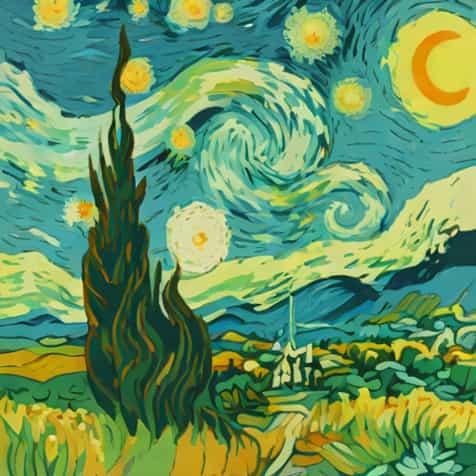
Color played a central role in van Gogh’s work. He often used contrasting and complementary colors to evoke mood and highlight particular aspects of his subjects. For instance, in Starry Night (1889), the vibrant blues of the night sky and the swirling yellows of the stars convey both wonder and turbulence, blending natural observation with psychological intensity. This approach to color aligns more closely with Expressionism, which prioritizes the emotional impact of visual elements over realism.
Brushwork and Texture
Van Gogh’s brushwork is another defining feature of his style. Thick, impasto strokes create texture and depth, adding to the emotional intensity of his paintings. This technique allows the viewer to see the artist’s hand in each work, emphasizing the act of creation as an expressive and intimate process. While Impressionists also used visible brushstrokes, van Gogh’s application often conveys agitation, passion, or introspection, setting him apart from the relatively detached observation characteristic of traditional Impressionism.
Impressionist Elements in Van Gogh’s Work
Certain aspects of van Gogh’s art reflect Impressionist influence. These include his interest in natural light, outdoor scenes, and vivid color contrasts. Paintings such as Sunflowers (1888) and Irises (1889) demonstrate his fascination with the transient effects of light and the beauty of ordinary subjects. Additionally, van Gogh’s adoption of brighter colors and looser compositions during his Paris years shows a clear engagement with the Impressionist movement. Yet, these elements are often infused with a psychological intensity and personal vision that distinguishes his work from conventional Impressionism.
Focus on Everyday Life
Like the Impressionists, van Gogh found inspiration in everyday life. He painted landscapes, gardens, and domestic scenes, capturing moments of ordinary existence. However, his interpretation is filtered through a lens of emotional resonance and symbolic meaning. The simplicity of his subjects is heightened by expressive techniques, creating a sense of immediacy and intimacy that goes beyond the Impressionist focus on optical effects.
Expressionist Tendencies
Many art historians argue that van Gogh’s work anticipates the Expressionist movement, which emerged in the early 20th century. Expressionism emphasizes the artist’s internal experience, emotional intensity, and subjective perspective. Van Gogh’s paintings often depict heightened emotions, psychological tension, and dynamic movement, aligning closely with these principles. His use of distorted forms, exaggerated colors, and expressive lines conveys feelings rather than purely visual impressions, a hallmark of Expressionist aesthetics.
Emotional and Psychological Depth
Van Gogh’s personal struggles, including mental illness and social isolation, are reflected in the emotional depth of his work. Paintings like Wheatfield with Crows (1890) and The Night Café (1888) convey anxiety, loneliness, and existential contemplation through color, composition, and brushwork. This focus on the inner world differentiates him from the Impressionists, who generally prioritized external observation and naturalistic depiction over psychological exploration.
Influence on Later Expressionists
Van Gogh’s expressive style had a profound impact on later Expressionist artists, including Edvard Munch, Ernst Ludwig Kirchner, and Emil Nolde. His willingness to convey raw emotion and subjective experience through bold color and dynamic brushwork helped pave the way for the development of Expressionism as a major artistic movement. In this sense, van Gogh can be seen as a precursor or early example of Expressionist tendencies, even though the movement itself emerged after his death.
Blurring the Lines Between Movements
Ultimately, van Gogh’s work defies strict categorization. While he absorbed influences from Impressionism, particularly in terms of color and light, his focus on emotional expression, psychological depth, and personal vision aligns more closely with Expressionism. This hybridity contributes to the enduring fascination with his art, as viewers and scholars continue to debate the precise nature of his style. The combination of observational skill, inventive technique, and emotional intensity makes van Gogh’s work uniquely compelling and difficult to classify within traditional artistic boundaries.
Legacy and Recognition
Van Gogh’s influence extends far beyond his lifetime, impacting multiple artistic movements and generations of artists. His innovative approach to color, brushwork, and emotional expression continues to inspire painters, illustrators, and designers worldwide. The debate over whether he should be labeled an Impressionist or an Expressionist underscores the complexity of his artistic vision and the richness of his contributions to art history.
Vincent van Gogh occupies a unique place in art history, with a style that incorporates elements of both Impressionism and Expressionism while transcending simple categorization. His early exposure to Impressionist techniques influenced his use of color, light, and outdoor scenes, while his emotional intensity, psychological depth, and expressive brushwork anticipate the principles of Expressionism. By blending observational skill with profound personal vision, van Gogh created a body of work that continues to resonate with audiences around the world. Whether one classifies him as an Impressionist, an Expressionist, or a pioneer bridging multiple movements, his artistic legacy remains undeniable, reflecting a profound engagement with both the external and internal worlds. His paintings are celebrated not only for their aesthetic beauty but also for their ability to convey the complexities of human emotion, making van Gogh a timeless and universally revered figure in art history.
van Gogh’s art challenges conventional labels, inviting viewers to appreciate the synthesis of style, technique, and emotion that defines his unique contribution to modern painting. His works remain a testament to the power of personal expression and the enduring impact of innovation in the history of art.